Exiting The Story of Our Lives on Our Own Terms
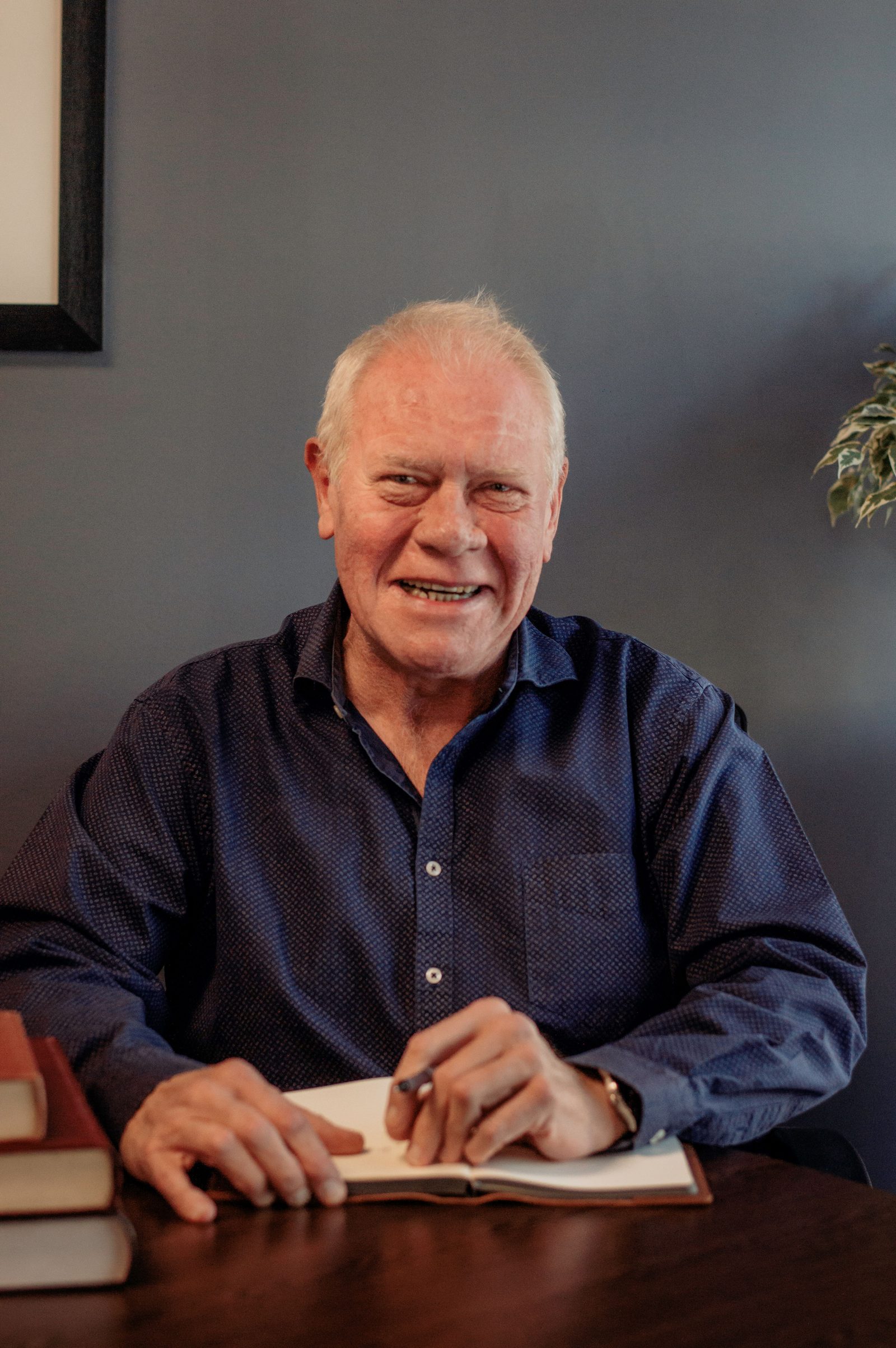
In this moving reflection, Professor Leon van Vuuren shares what he has learnt having been a part of the lives of three people who had Motor Neurone Disease. Prof van Vuuren was the Executive Director: Organisational Ethics at The Ethics Institute (TEI) for 12 years until his retirement in March 2026. He is currently an Extraordinary Professor in Industrial Psychology at Stellenbosch University and an adjunct professor in Organisational Psychology at UCT.
What can one learn about assisting people who suffer from incurable and eventually unbearable afflictions to exit the stories of their lives with dignity? The stories below represent reflections on how three humans, Mrs H, Mr T and Mr C, who all had MND, shaped my thinking about life and inevitable death. But perhaps inevitable death with a difference. My own life and that of others in good health, who may not need to seriously contemplate their impending death at this point. More importantly, for those, myself included, who may at any given moment be given a medical death sentence, or others who have already been sentenced, so to speak.
Let’s start with the story of my mother. Mrs H died in April 2005, aged 84, after severe MND related complications: extensive muscle weakness, trouble swallowing, and total loss of speech and facial expression. She was diagnosed 17 months earlier, but probably contracted the disease one to two years prior to the diagnosis. I watched her die slowly. For months I saw the sparkle of life gradually waning from her eyes. I observed her silent tears caused by deep emotions based on helplessness and frustration. This whilst knowing that her cognitive functioning was fully intact. For me her suffering was devastating.
Mr T, a family member in his early 70s to whom I was very close, was diagnosed with MND in 2024, but its onset was probably two to three years before the definitive diagnosis. I was already well-informed about the ‘Switzerland option’. I was also by that time fully aware of the existence of Dignity SA, its cause and the support it provided. Yet, MAiD (Medical Assistance in Dying) was, and still is, illegal in South Africa. Since MAiD was then already in my mind and vocabulary, I discussed it with Mr T on several occasions. Initially he was, besides being unaware of the possibility of reverting to MAiD, totally opposed to it. The main reason for his reluctance to consider it was primarily based on his religious conviction that us as humans cannot decide when to stop living, as such an outcome was in the realm of the divine being in which he put his trust.
Due to his increased levels of suffering he started to contemplate ‘soft’ suicide options, one being OD-ing on sleeping tablets, for example. He informed me that he had changed his mind, clearly in a relatively short space of time, about the MAiD option, but was also aware of its illegality in South Africa. He was deterred from eventually executing the suicide option, since his substantial life insurance policies would be null and void in the case of suicide. Mr T eventually died of a breathing related MND complication 11 months after having been diagnosed. A month or two prior to his death, in one of our ‘Tuesdays with Morrie’-types of conversations, he told me that he was considering the Bobby Sands-approach, that is ceasing his food intake, as a way to exit the story of his life before the onset of real suffering. However, due to their lack of knowledge on MAiD and existing dogmatic belief systems, his family was vehemently opposed to it and would never have supported such a decision.
At the other end of spectrum, an acquaintance, Mr C, died with dignity at the end of 2025 aged mid-60s in the country he emigrated to many years ago. Having lived with the knowledge of having MND for two years prior to his passing, he managed those two years by taking actions that may seem unthinkable to the majority of people who believe in healing, or, if slightly less spiritually evolved, in less suffering, by resorting to prayer. After much soul-searching and deep and lengthy discussions with his loved ones that culminated in unconditional support he made his own decision about ending his life. For rational reasons and before intense suffering and shame could ensue. The joint family decision, however, did not automatically spare his family from a deep sense of impending loss and grief. They supported him fully though, and together walked the road to final moment.
Mr C travelled thousands of kilometres in a motorhome with his spouse and visited places they had previously only dreamed about. He visited all his family across the world and had many social interactions with his children and their families. When the time came Mr C greeted those around him and took the final step by checking into a medical facility to write the last chapter of the story of his life on his own terms and with dignity. He could do this, as he resided in a country where controlled MAiD is legal. I had clarity that few people around the world are able to choose this route legally though.
My mother’s situation caused me to realise that dying having lost one’s dignity was not the way to go. I made a firm decision that I would never allow myself to die in similar fashion, but do something about it before severe complications set in. Back in 2005 I had not yet contemplated MAiD should I ever have the need for it, as I was, at the age of 46, not consciously aware of the possibility I or other humans could have the option to die with dignity. Provided of course that one has the required decision-making capacity to select this option, be it medically administered or even having the opportunity for self-administration with the appropriate medical supervision.
Twenty years passed between the deaths of Mrs H and Mr C. During that time more people have become aware of the MAiD option. The publicity that surrounded a number of recent court cases in South Africa where MAiD was applied, albeit illegally, actually triggered more interest in the practice. The stories relayed above should verify this to a small extent. What can one take from these stories in practical terms, however?
A crucial push to eventually gain acceptance for dying with dignity is to continually stimulate dialogue around the topic. Collective action between relevant and influential stakeholder organisations should be pursued in a concerted and structured manner. A central and collective premise should be to change the values of society around this topic. There should only be one end goal in mind: bringing voluntary dying with dignity into the national vernacular.
The continued effort to legalise voluntary MAiD by Dignity SA can go a long way to helping many to avoid death with much suffering for all and sundry and little dignity for the sufferers. Although the stories relayed in this article are based on a subjective personal reflection, Dignity SA’s approach will naturally be based on substantive and internationally accepted theoretical models and globally accepted objective empirical evidence.
The organisation’s efforts should not be thwarted by naïve and emotionally laden comments by so-called experts from professions and organisations who, for example, argue that ‘there is no pain that is so bad that it justifies the will to choose dignified death’, keeping in mind that pain goes way beyond the physical dimension only; there is clearly also emotional and existential suffering, be it chronic or shorter term intense suffering. Nor should efforts to legalise MAiD be deterred by those who continue to make the case that decisions to end a life of current or imminent suffering cannot be made by humans themselves.