Leigh’s Story
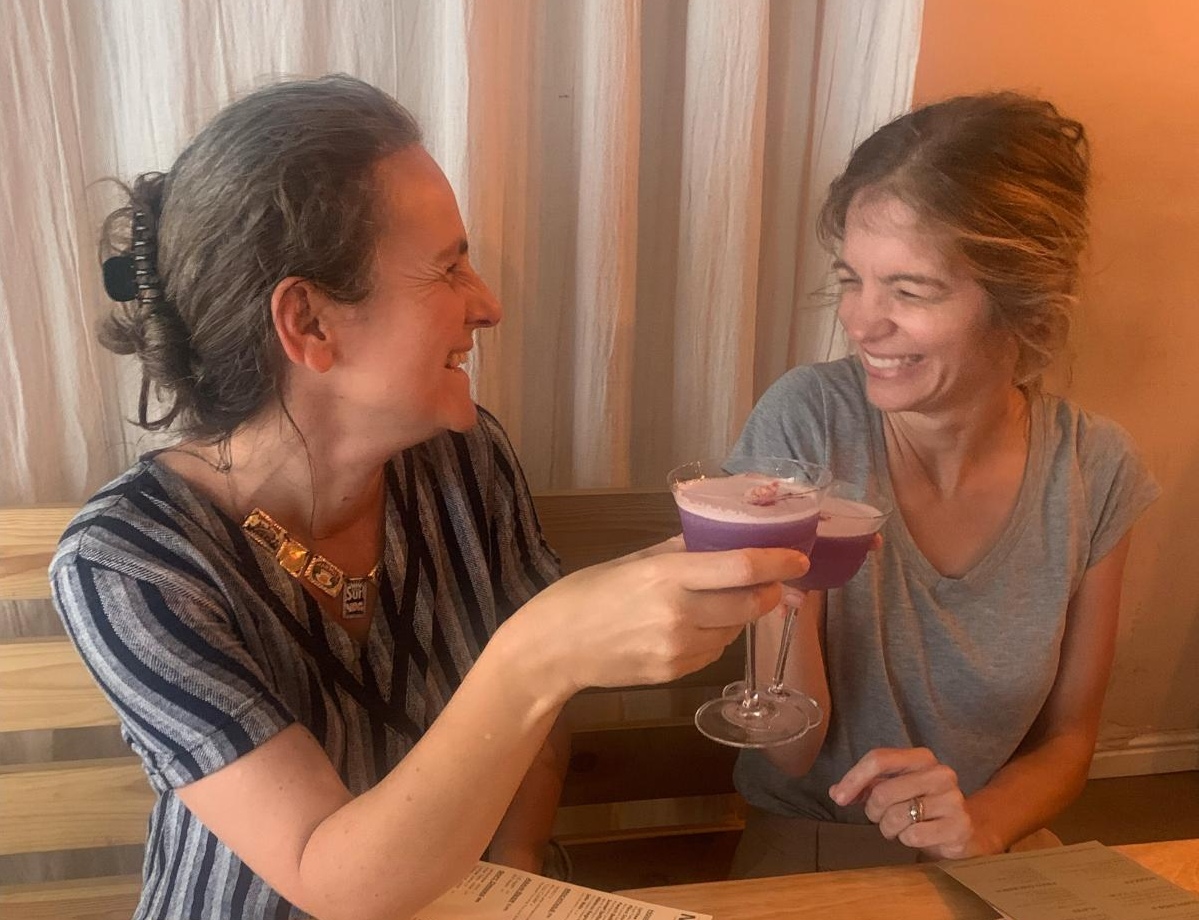
This Women’s Month we will be sharing stories of strength, compassion, and choice from some of the women behind DignitySA. Leigh Meinert, our Operations Manager, (pictured left) begins this series for us by describing how two profound losses, decades apart, shaped her passion for end-of-life care and the right to dignity.
I was 15 when my friend Damian died by suicide. I had seen him just that morning, the first day of our spring school holidays, and he had told me that his plans were to “lie in the grass”. He suggested that we go see a movie that night, but I was non-committal.
The day came and went, and it was dark out when his mother called, wailing. As the sun was setting, he had shot himself and was found lying dead in a grass patch just behind their home.
My mother drove me there, and I will never forget how a lone candle was burning in a window as we arrived, and how an incredible sense of calm came over me as I stepped across the doorway. Somehow, at 15, I knew how to be. In the week that followed, I barely left their home, going from room to room supporting where I could. I spoke at his funeral, and afterwards, when I returned to school, nothing seemed real anymore.
Wracked with guilt that I had not listened well or picked up the signs, I threw myself into work with young people like myself and Damian. I tried to build bridges across the gulfs apartheid had engineered as democracy dawned in South Africa. That led me to work in education and help to co-found and lead a free-to-student business school in Cape Town.
But at the back of my mind, I always knew that my second career would be to help people who were dying.
As I approached my 40s, I decided to make the leap. I was one of the first people in South Africa to be trained as a Soul Carer by the incredible Reverend Mary Ryan. This inspired me to organise the first conference in SA for aspiring death doulas like me.
In February 2020, 155 people came from around the country to attend my two-day gathering on ‘Midwifery & Dying’. I was amazed, and so were they. Over and over again, I heard people say, “I feel like I have found my tribe.” It turns out that there are many of us who are comfortable and keen to talk about death, and our numbers keep growing.
Fortunately, in the midst of Covid, I was able to secure a new job as the Advocacy Manager for the Hospice Palliative Care Association (now the Association of Palliative Care Centres). I was passionate about raising awareness about palliative care. It was for this reason that I was approached, in September 2024, by a director of DignitySA who wanted to understand why so many in the palliative care sector were opposed to medical assistance in dying (MAiD).
I shared my understanding and encouraged the directors to consider advocating for access to palliative care, as well as MAiD, if they truly wanted to ensure that suffering at the end-of-life was eased. I assisted with some connections and advice where I could.
Then it all became very real. In October 2024, my step-sister Jennie shared with us her decision to go to Switzerland to take up assisted dying in a year’s time. She had been diagnosed 16 years earlier with cerebellar ataxia, a progressive illness for which there is currently no cure, and she was clear-eyed about her decision that, shortly after her 40th birthday, she wanted to end her life on her terms.
Jennie lived in the UK, so I dipped deep into my savings and booked tickets to travel with my two daughters, aged 11 and 13 at the time, to go and say goodbye to her. I wanted them to witness her quiet strength and calm and to learn from her example that death does not have to be feared.
Despite her age, Jennie felt like my older sister, and we had long chats, especially in the last six months of her life. She adored fruity cocktails, chocolate, coffee, sushi, books, young children and her husband (they had been together for 19 years and decided not to have children because of her illness). She was not morbid or depressed. In fact, making and communicating her decision gave her a significant sense of relief. She chose not to speak of it widely for fear that people might try to convince her to change her mind. But around the dinner table with my girls, she would, and they were amazed by the peace and comfort that she had with her own imminent end.
On the day that she died in September 2025, I spent the morning sitting quietly on a bench in Newlands Forest, recalling especially the last walk that we had taken with her in the woods of Sevenoaks, just outside of London. She used a walker and had to go exceedingly slow.
Slow has been my mantra in this past year and one of the ways that I honour her. I call her husband every week, a promise that she did not ask of me but one that I told her I would keep, and I learn from him now too.
My work at DignitySA is another way that I honour her, Damian, and all those whom I have loved and lost. I know I am not alone in trying to make sense of it all. In searching for meaning and, at the very least, in practising a little more kindness.
Perhaps, as the poet Naomi Shihab Nye writes,
Before you know what kindness is you must lose things…
Then it is only kindness that makes sense anymore,
only kindness that ties your shoes
and sends you out into the day to mail letters and purchase bread,
only kindness that raises its head
from the crowd of the world to say
It is I you have been looking for,
and then goes with you everywhere
like a shadow or a friend.
* This story was written by Leigh Meinert, DignitySA’s Operations Manager, who is pictured above left with her sister Jennie (on the right).