Lynne’s Story
When I was 29 my husband, the father of my two children, was admitted to a cardiac ICU in Johannesburg. He spent two years there, fighting. He was not a man who wanted to let go. He took on every treatment, every trial, every hard road because he wanted more time, more years, more life with his children. In the end the fight took him anyway. I was left with two small children and a grief that had nowhere to go.
A few years later my parents became ill. My father went first, taken piece by piece over years by Parkinson’s. His hands, then his voice, his walk, his certainty, until there was almost nothing left of the man who used to move through the world so kindly and easily. He had palliative care, and for a long time it helped him and was good, right up until it wasn’t.
We learned to watch. That was the hardest part, if I’m honest. Not the dying itself, but standing at the edges of it, useless, present, quiet, waiting for the inevitable.
A year after we buried him, we were back at the same graveside for my mother. Merkel cell carcinoma has spread to the bone, relentless and slow. She had palliative care too, but at the end, her pain was not controlled at all. It was agonising in a way I still don’t have words for, and equally agonising to witness, knowing there was nothing left that anyone could do about it.
Two long slow deaths, back to back. Three educations in what it costs a family to lose someone one small loss at a time, and in how even good care can run out before the dying does.
Then came Dieter Harck.
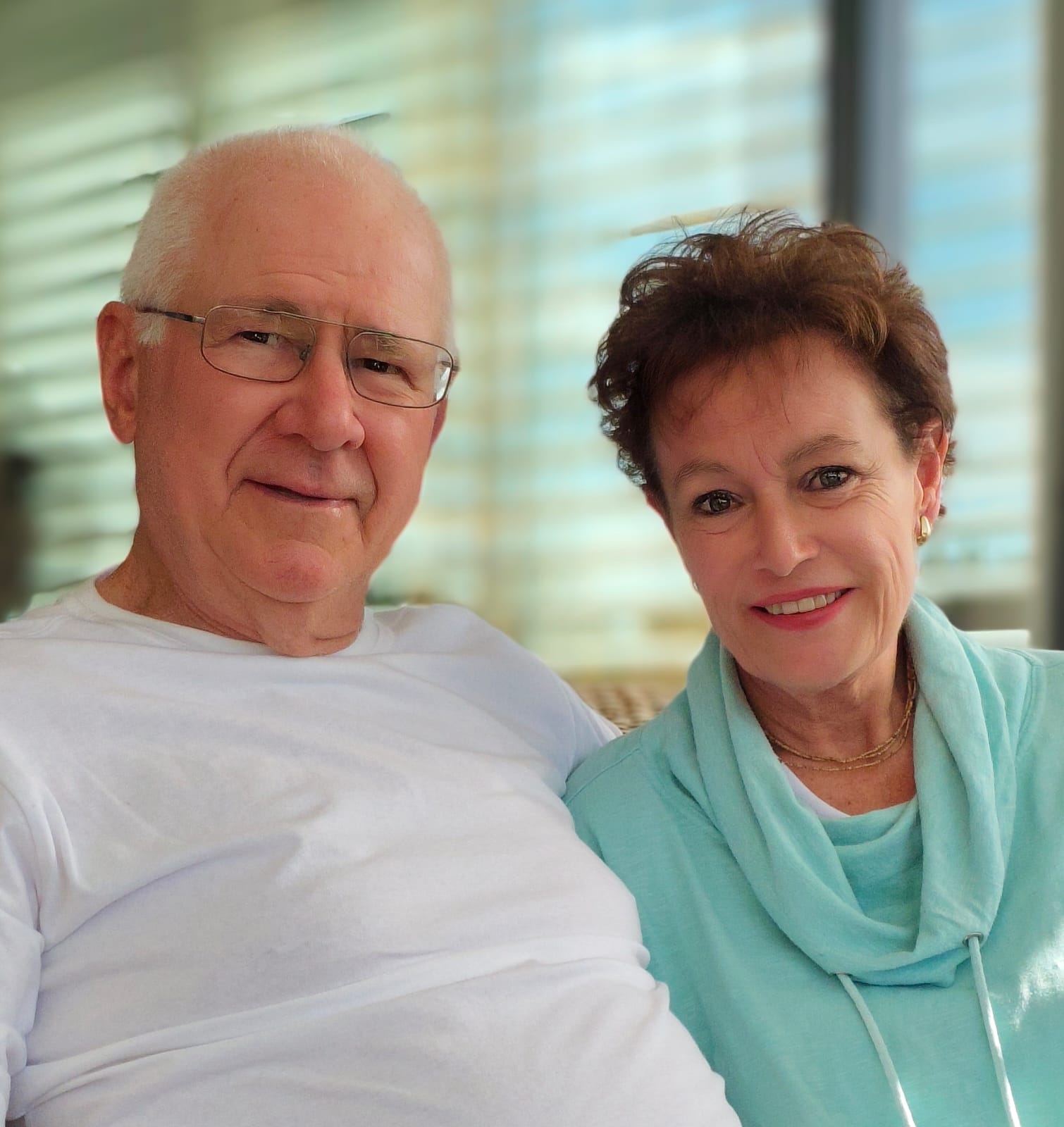
When I met Dieter he was a man made of motion, determination, kindness, discipline and a great love for life. He was a broker-owner of a RE/MAX franchise in Johannesburg, running on an energy that seemed to have no bottom. We built a working partnership before anything else, years side by side in the same industry, and somewhere in all that shared momentum, love found its footing. He was, by every measure, one of the most alive people I had ever known.
So it was almost impossible to watch, at first, the small failures that crept in, the falling, the dropped things, the swallowing difficulty, the words that started arriving a beat slower than they used to. The diagnosis, when it came, was Motor Neurone Disease, also known as amyotrophic lateral sclerosis (ALS). Five years, we were told. Five years to build a life’s worth of things into whatever time remained.
We didn’t spend those years in mourning. We spent them travelling, hard, deliberately, and gratefully. We worked just as hard alongside it, building a bucket list and then simply living it, one item at a time, while Dieter’s body slowly renegotiated the terms of what he could do.
Then came a strange mercy in the middle of the hard news: it wasn’t ALS after all. It was primary lateral sclerosis (PLS), a rarer, slower cousin of the disease. It wasn’t going to take him on the timeline we’d been given, it gave us a few more happy years to spend together.
From the day that Dieter was diagnosed he wanted the choice to get assistance in ending his life in a safe and dignified manner. I set out to become a death doula. I trained to sit with the dying and the people who love them, the way no one had quite been able to sit with me. I knew, from the inside, what it meant to hover at a bedside not knowing what to do with your hands. So I made it my work to know what to do with them.
Fifteen years later, he is still here.
Still fighting the disease that reshaped both our lives, and still living inside a body that has taken so much from him but never quite all of him. Through all those years, one fear has sat beside him more constantly than any symptom: not death itself, but the manner of it. Motor neurone disease is not known for gentle endings. Dieter has asked, clearly and consistently, for the right to choose how he will die and has been told, repeatedly, that no one is permitted to help him.
I now serve as a director with Dignity South Africa, standing at the front of the fight to bring assisted dying law to a country that doesn’t yet have it. This is not an abstraction for me. It is the very thing my partner is asking for, out loud, from the middle of his own long illness.
If I trace the shape of my own life, it draws a single line: a woman taught, again and again, what it costs to die badly and what it means to die held. Two parents lost slowly. A young husband who fought to stay. A partner still fighting to stay, on his own terms, for as long as he chooses, while asking only for the dignity to choose the ending too.
I’ve spent my whole life at the edges of other people’s dying. First as a daughter, then as a widow, then as a doula, now as an advocate. Every version of me has been trying to answer the same quiet question, not how do we stop death, but how do we make sure no one has to face it alone, or afraid, or without a say in how it comes?
That is my story. Not a woman defined by loss, but one who kept walking back toward it, every time, to make it kinder for whoever comes next.
Palliative care is good. I have seen it work, and I have seen what it gives people when it holds. I have also seen it run out. I have watched it stop being enough while someone I loved was still in the room, still suffering, still waiting. Good is not the same as enough. And in the space where it runs out, the choice has to belong to the person living it, not to the rest of us standing at the edges. Nobody else gets to decide how much pain is acceptable for someone else to carry, or how their story is allowed to end.
It is their choice.
If you stand with Lynne and Dieter, please sign our petition to decriminalise medical assistance in dying and help us to grow support for this.