Sanja’s Story
“Just take me out back and shoot me.” This is my mom’s tongue-in-cheek but constant refrain for as long as I can remember, whenever terminal illness, aging, and death come up. “Yes, fine,” I always tease back, to banish both the thought of her dying, and the ridiculous suggestion that executing her like a broken-legged horse in an old Western would save her from suffering and indignity.
As much as I know she is joking, I also know there is real fear behind the hyperbole. Fear of unbearable pain, fear of losing oneself, fear of simply wasting away at the end. That this short life on earth will be senselessly punctuated with more of the worst of it. I always understood why she felt this way, and strongly shared her view. To be honest, there do not seem to be people, old or young, in my orbit who do not feel the same way. But the prospect was distant enough for me to defer facing it.
Then, in December of 2024, our fear of suffering at the end of our lives snapped into razor-sharp focus for me. My grandmother, 92 at the time, had a catastrophic stroke on Boxing Day, and was rushed to hospital. It left her unable to speak, her mouth frozen open in what looked too much like an anguished cry. In the hospital, she was mostly sedated. But in the fast-shrinking windows when she seemed awake, her ability to move was limited to being able to clasp my mom’s hand in hers, while groaning with heart-breaking urgency, and agitated fits of flailing her limbs and pulling at the various wires and tubes in her frail body. Her hospital gown kept falling open, exposing the nappy she had to wear. Were the clasping, groaning, and flailing my gran’s way of telling us, and everyone else, to just make it all stop? That she wanted to go home? That she wanted to die with dignity? No one could say if she was in any way aware and communicating, or if the stroke had scrambled and taken her mind completely away.
In her lifetime, my gran was an immaculately groomed, coifed, and very dignified woman. If she was at all aware of what was happening to her in that hospital bed, she would have been in abject hell. I think that was what traumatised my mother the most. The horror juxtaposition of how my gran had lived, and how she was now dying. But my gran had never told us what her advance health care wishes were – not something a woman of her background ever felt comfortable discussing. After a few days, the doctor said any more hospital treatment was futile, and that we might choose to stop intravenous food and hydration. Even with pain relief and sedation, how do you dehydrate and starve someone you love to death? No. Just no. Would she want that? We didn’t know. Would she prefer it to the needles and tubes, stiff sheets, and smell of disinfectant? We didn’t know.
We decided to move her to hospice care. In a sterile white room, in a bed not her own, she was made as comfortable as possible by the literal angels that are the palliative care staff. I cannot fully describe how in awe I am of people who can be so surrounded by imminent death every day, and still exude nothing but kindness and compassion. On 15 January my mom and I were visiting. We had no idea if my gran was aware of who we were, or even our presence, because she was never awake anymore. She was a deeply religious woman, but I am not, so I hoped that the Bible passages I awkwardly pulled up on my phone were the ones she would have wanted to hear. I read to her while my mom brushed her hair, put lotion on her hands, and played her favourite Neil Diamond songs. As we left, we thanked the angels for their gentle, precious care. Fifteen minutes later, and 20 gruelling days after her stroke, my gran died.
It was during her first days in hospital that I decided to make urgent work of supporting the decriminalisation of medical assistance in dying, and all things advance directives. What I saw in the hospital, I could not unsee, and I refuse to let that be the death of even one more person I love, if I can help it. I have spent my entire legal career in the public interest law and human rights sectors. I know law reform, I know legal advocacy, and I know impact litigation.
As it turned out, I also knew an executive director of DignitySA. Between Christmas and New Year I did a bit of Googling and there was DignitySA, clearly the authoritative organisation on MAiD in South Africa, and already championing the cause for many years. And lo and behold, there was Prof Joseph Raimondo, whom I had met through friends around 2009, but had not seen in well over a decade. I resolved to get in touch with him in the new year.
On 4 January, even before my gran passed, I walked to the deli on the corner of the street where I live, with a sandwich in mind. I saw a man in profile, standing on the curb. I considered whether I was seeing things because of what had been on my mind. I looked again. You won’t believe it, because I barely did.
“Joseph Raimondo?” I said, a little incredulously.
“Yes?” said the man, as he turned toward me.
“What brings you here? Do you live nearby?” I asked.
“Nooo, I live in Newlands,” he replied.
Hot damn. I could barely get the pleasantries out of the way fast enough to tell him that I wanted to help at DignitySA, straight away.
A week later we were meeting again, for another sandwich at the deli, and this time with Alison Tilley – the powerhouse who taught me everything I know about advocacy. Because, and you won’t believe this either, she has always said that the decriminalisation of medical assistance in dying was a law reform campaign she would relish. Joseph told us about the people and considerable history of DignitySA, and we were on board with the mission without further ado. As I said, I’m not religious, but I do believe in serendipity, synchronicity, and providence. The rest is history – in the making.
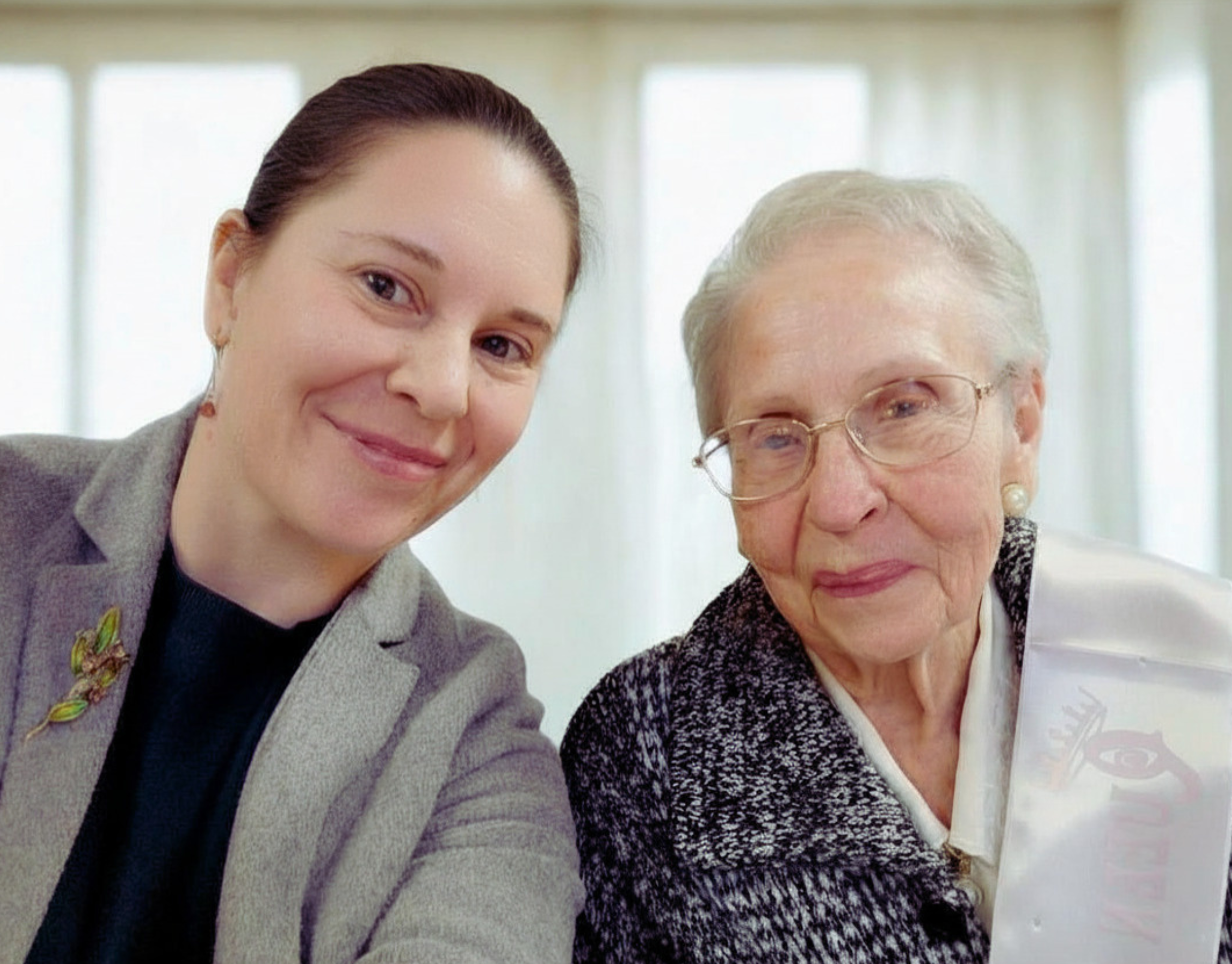
This Women’s Month we are sharing the stories of the women behind DignitySA. Sanja Bornman (pictured above with her grandmother) is one of our directors and you can join her in making history happen by becoming a member of DignitySA and signing our petition to decriminalise medical assistance in dying. Please visit our homepage for more.