MAiD in SA: What Do Religious Leaders Say?
What Do Religious Leaders Say about MAiD?
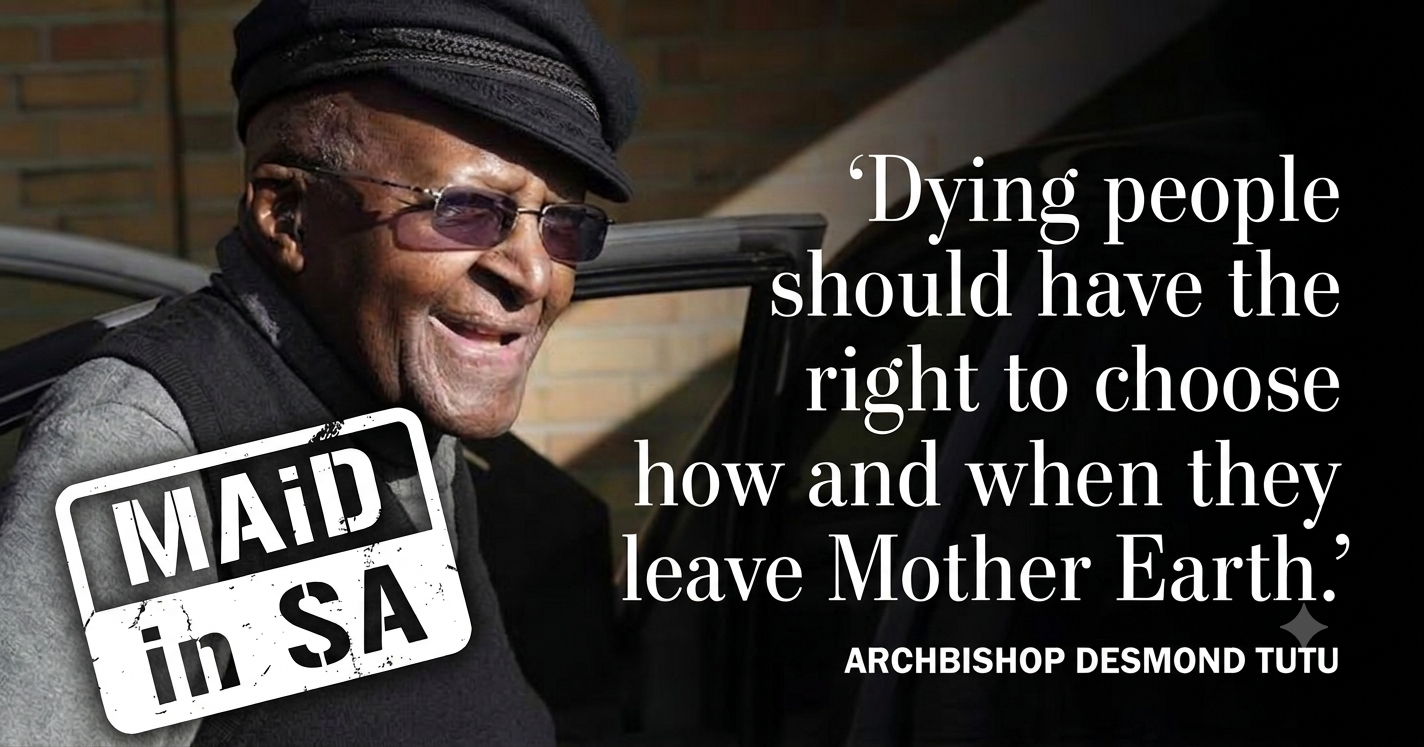
Across every religious tradition, ordinary believers and trained theologians alike hold divergent views on the ethics of medical assistance in dying (MAiD). This is not a disagreement between the faithful and the faithless, it is a disagreement within faith itself. In the Christian tradition, for example, the late Archbishop Emeritus Desmond Tutu spoke openly and courageously about his conviction that MAiD could be reconciled with his deep Christian faith, framing a dignified death as consistent with a God of compassion.
Other Christian theologians, drawing on the same scriptures and the same tradition, reach the opposite conclusion. Similar debates run through Judaism, Islam, Hinduism and every other faith community. There is, in short, no single “religious” position on MAiD — only a rich and unresolved conversation.
This is precisely why, in South Africa, our Constitution serves as the arbiter of public policy. It does not adjudicate theological disputes, nor should it. Instead, it sets out the rights of every citizen, of all faiths and of none, while remaining neutral on the intra-faith disagreements that no state should presume to settle. The power of a constitutional democracy, as we have in South Africa, is that it makes room for people who profoundly disagree with one another to live together under a shared framework of rights.
Crucially, a constitutionally conferred right is a freedom, not an obligation. An individual is always free to decline a right they hold, whether for religious reasons or reasons of personal conscience. Should MAiD become legal in South Africa, those who believe it to be wrong would remain entirely free to reject it for themselves, in the same way that those who oppose the termination of pregnancy, or same-sex unions, are not compelled to enter into them.
Legalising a choice is not the same as mandating it. It simply extends to each person the dignity of deciding, according to their own beliefs, how to face the most personal moments of their lives.