Dignity Matters
Our bi-monthly newsletter with interviews, expert input, entertainment, local and global news for the DignitySA community.

From the Chairperson's Desk
9 April has come and gone.
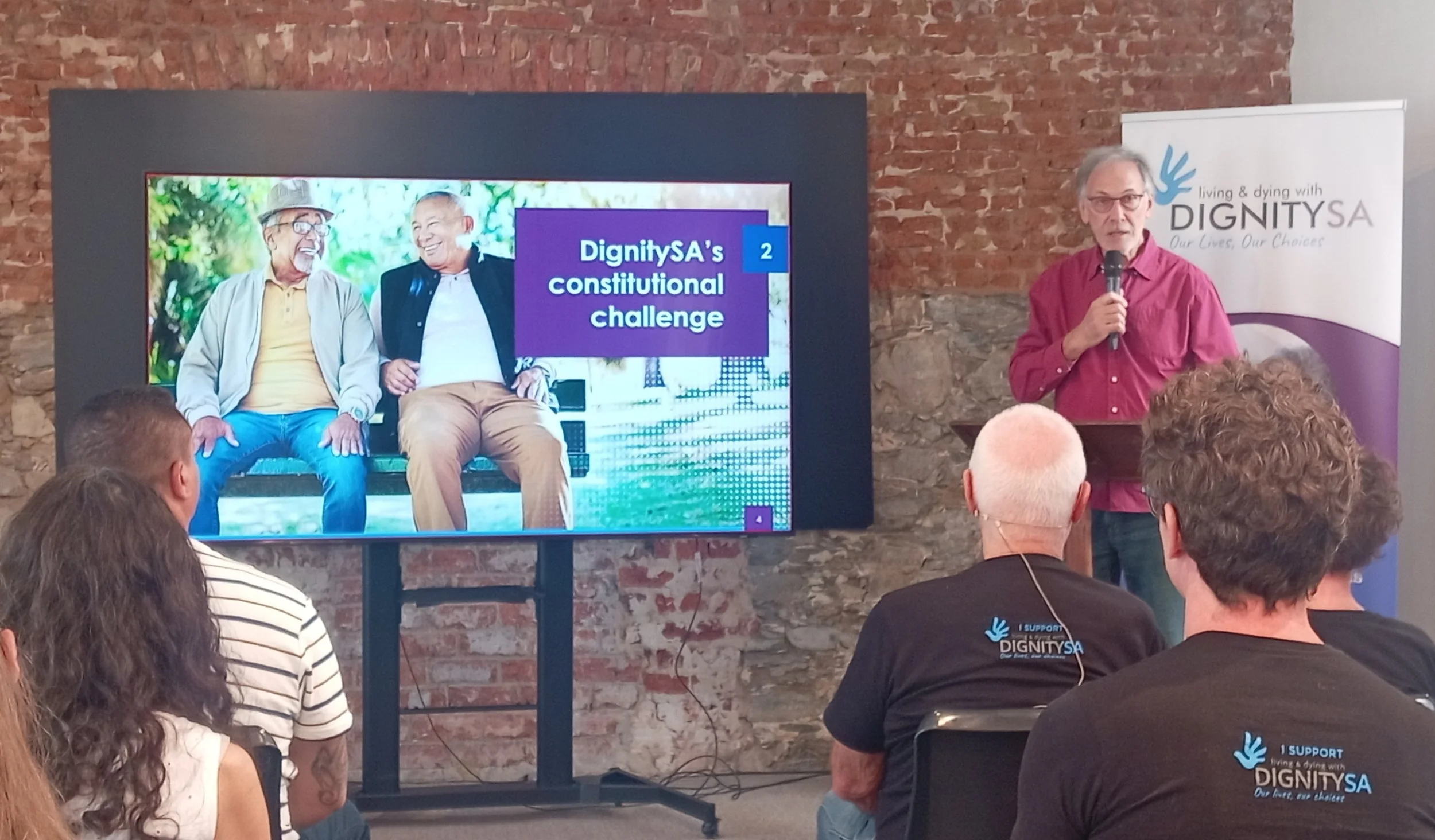
On that day, DignitySA approached the High Court in Pretoria with our medical assistance in dying (MAiD) constitutional challenge and hosted a media event in Cape Town, at the Desmond and Leah Tutu Foundation in District 6.
It was the outcome of more than four years of preparation to bring the best possible legal application to the Court. Many individuals contributed to our reaching this point, but it is our legal team that deserves the highest praise.
Since then our case has been featured in the media (online, print, TV and radio) over 200 times. That is beyond expectation. We thank media houses and journalists.
The deadline for the four respondents to indicate their intention to oppose us was 8 May. At the time of writing this editorial, only the Health Professions Council of South Africa (HPCSA) has done so. What the remaining three respondents' intentions are we do not know yet (two ministers and the NDPP). Nor do we know how the Court will handle disregard of its deadlines.
We now await (at least) the HPCSA's answering affidavit. Amici curiae may join the appellant, DignitySA, or respondents. Then DignitySA will have the opportunity to submit a replying affidavit. Once all documentation is in, the parties will square off in Court.
One significant feature of reactions to our legal initiative has been the question about the relationship between MAiD and palliative care. Would good palliative care make MAiD redundant? Is there suffering (not just pain) that is beyond the reach of palliation? Are MAiD and palliative care from different universes, or synergistic? Why do some palliative carers have principled objections to MAiD while others' experience with suffering and dying patients lead them to support MAiD unequivocally?
Leigh Meinert, who was an Advocacy Manager for the Association of Palliative Care Centres, and now is DignitySA's Operations Manager, is ideally placed to address this relationship in an informed and balanced way and does so in this issue.
DignitySA wishes to pay tribute to Marianne Thamm whose Exit interview appears in this issue. Marianne and I first met 14 years ago, in 2012, when I presented a position paper on the SA Law Reform Commission's (SALRC) 1998 report on end-of-life choices. In 2013, Marianne published a moving book on the life and death of Craig Schonegevel (which is also reviewed in this issue). Over the years, in numerous Daily Maverick articles, Marianne made discerning and incisive contributions to the public discourse on MAiD.
We thank Marianne, and all of you, for bearing with us in the long run-up to our Court challenge. I am delighted to be able to report that it is finally underway.
Prof Willem Landman, Chairperson, DignitySA
The Exit Interview
Dignity Matters poses some questions to:
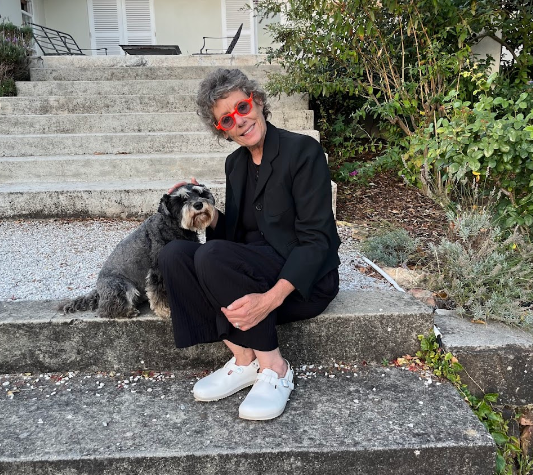
Marianne Thamm is a South African journalist, author and stand-up comedian. She is the assistant editor of the Daily Maverick and has written several books, including The Last Right: Craig Schonegevel's Struggle to Live and Die with Dignity, which is reviewed in this issue.
If calories and indigestion were no object, what culinary indulgence would be your last?
A toasted cheese and tomato sandwich and a cold Coke.
Ideally, how would you like to go?
Hopefully in my sleep, suddenly, while clutching a book. It's on my vision board. If that is not possible then at home with my loved ones.
In what publication would your obituary appear, and what would its glorious and slightly exaggerated but still truthful headline be?
Well, I won't be around to read obits so have no idea where it would appear. If Herman Lategan is around he would probably write something because he knows how we feel about traditional obits. A good headline would be: "She came, she lived, she left".
Imagine your memorial service. What music would be playing? What band or artist would be grateful for the opportunity to perform?
Well considering again I might be dancing with the particles and not be able to hear a thing, I will leave that to my darling partner, children and friends to decide. I have a few songs written down and then crossed out over the years, so there is no point leaving that list around, it will just confuse anyone. Those gathered would be there for a week. The one thing I do wish I could keep my ears out for is to hear my daughter Kenya sing, if she wants to.
Burial or cremation? If transport, permissions and expense were no problem, where would you like to be buried, or have your ashes scattered?
I used to think I would love to be scattered around the Labia Theatre in Cape Town. That place brought such magic and still does. Besides the name is just ridiculous and no one thinks of the Count it was named after. So, cremation. I am too squeamish about being boiled in an aquamation like Bishop Desmond Tutu. Newlands forest would be good.
If you could choose one object to be buried or cremated with, what would it be and why?
Pictures of my children and my partner and my dogs so that they can accompany me to the afterlife.
If you were to haunt someone after your demise, where would it be and why?
Politicians. I would play tricks on them, drive them nuts.
Who is in your will? And is there anything that you are leaving that may cause a fight?
My family is my will. I have loads of books which I hope to donate to a library and not leave for my children to deal with. There are many precious signed books, like Hugh Masekela's biography, my Zapiro annuals, my Zapiro cartoons and my huge Bob Marley poster that I hope my children will like and keep. Unless I win the lottery there would unfortunately not be much left for a cause but if I did I would leave it to Philsa Abafazi Bethu (PAB), a remarkable place of safety and education started by Lucinda Evans in Lavender Hill and that has offered refuge for babies, women, children and others. Visit the website and see and then also fit PAB into your will. If there was any money left over I would leave it to animal welfare.
What do you still need to do before you kick the bucket?
What I do every day and enjoy and love.
Finally, is there anything you've secretly wondered about death, but been too polite to ask?
Not really. I have made friends with death. I was there when both my mother and father died and if you are lucky enough to live as long as I, there have been many dear, irreplaceable souls who have died. I live each day for them. Steve Jobs reportedly said "oh wow, oh wow" as he died and I am looking forward to the fireworks.
Expert Input
Perspectives on Palliative Care & MAiD in SA
People often ask me why there is reluctance within the palliative care community to support medical assistance in dying, or MAiD. As a former Advocacy Manager for the Association of Palliative Care Centres (APCC), I understand that there are many reasons for this, and I have sympathy with most of them. What follows is not a comprehensive account of the views of palliative care practitioners, but rather my own perspective.
Where We Agree
If palliative care was more accessible, people would not need MAiD
Palliative care is a comprehensive form of patient-centred care that can do a great deal to relieve total pain, meaning not only the physical pain that dying people may fear, but also emotional, social and spiritual distress. Regrettably, because of limited government prioritisation and inadequate funding, it remains difficult for the average South African to access high-quality palliative care. Faced with a terminal diagnosis, limited access to palliative care, and limited understanding of what palliative care can offer, some people may understandably see MAiD as the only way to regain control or avoid suffering. That is a serious concern. It is why we believe that high-quality palliative care should be available from the point of diagnosis, and that access to such care should form part of any responsible framework for MAiD.
At DignitySA, we fully agree that palliative care should be accessible to all. Meaningful access to high-quality palliative care should be a precondition, and one of the eligibility considerations, before access to MAiD. MAiD should not be offered where palliative care is absent, or where inadequate or substandard care compromises genuine freedom of choice.
However, in our experience, palliative care cannot relieve all suffering in all cases. Even those who are able to access excellent care may still endure suffering they experience as intolerable. For this reason, we do not see palliative care and MAiD as an either-or choice. Rather, we see access to MAiD as sitting on a continuum with palliative care.
MAiD gets the attention and resources that palliative care sorely needs
MAiD is an attention-grabbing issue around the world. In a country where only approximately 18% of people are currently able to access palliative care, many in the sector feel that the spotlight should be firmly on improving access to palliative care instead. We agree that this is a vital priority, which is why palliative care is one of DignitySA's focus areas. Our aim is to use the public attention that MAiD receives to highlight the urgent need for increased support for palliative care. A good example of this was our SABC TV interview last month.
International experience suggests that assisted dying and palliative care need not be advanced in opposition to one another. In Belgium, palliative care and euthanasia developed side by side, where both fields were strengthened by a broader societal focus on end-of-life care. In Canada, the legalisation of MAiD was followed by a national Framework on Palliative Care and an Action Plan focused on improving access, quality and system performance. In Australia, Victoria and Western Australia both introduced voluntary assisted dying in a context of new or expanded investment in palliative and end-of-life care. France is currently debating assisted dying alongside a major palliative care plan, while in the UK the assisted dying debate has coincided with renewed attention to hospice funding, including a £100 million investment described as the biggest in a generation.
These examples do not prove that MAiD automatically improves palliative care. But they do challenge the idea that the two must compete for attention or resources. The better lesson is that when societies take end-of-life care seriously, they tend to confront the whole landscape of dying: symptom control, family support, hospice care, patient autonomy and the small number of cases where suffering remains intolerable despite good care. We therefore do not see this as a choice between access and autonomy, or between palliative care and MAiD. We see an opportunity for both movements to strengthen one another around a shared, patient-centred goal: better care, better choices and greater dignity at the end of life.
Palliative care practitioners cannot be associated with MAiD
One of the core tenets of palliative care is that it neither seeks to hasten nor postpone death. This principle is sometimes misunderstood. Palliative care practitioners may, ethically and appropriately, use medications such as morphine to relieve severe pain or distress, even where there is a foreseeable possibility that such treatment could shorten life. Under the principle of double effect, what matters ethically is that the treatment is proportionate and that the primary intention is to relieve suffering, not to cause death.
This distinction is important. In palliative care, death may sometimes be a foreseen but unintended consequence of symptom control. In MAiD, by contrast, the intention is to assist an eligible person to die in response to their considered request. The two practices are therefore ethically, clinically and institutionally distinct, even though both are concerned with suffering at the end of life.
We understand why many palliative care practitioners are anxious about any association between palliative care and MAiD. Misconceptions about palliative care already deter some patients and families from seeking it, particularly the mistaken fear that palliative care simply means sedation, abandonment or the hastening of death. For this reason, it is vital that any legal framework for MAiD should protect, rather than blur, the identity and integrity of palliative care.
Indeed, the experience of jurisdictions such as Canada suggests that when MAiD is legally recognised and separately regulated, it can help make the distinction between assisted dying and palliative care more explicit. Rather than leaving patients to confuse palliative care with covert life-ending practice, a clear legal framework can clarify that palliative care is focused on living as well as possible until death, while MAiD is a separate option governed by its own criteria, safeguards and professional responsibilities.
We therefore agree that palliative care and MAiD are not the same. We also do not envisage that palliative care practitioners would necessarily be the professionals administering MAiD, should it become legal in South Africa. For these reasons, while we understand why some palliative care practitioners cannot be seen to support MAiD, we hope they will not stand in the way of a carefully regulated legal framework that preserves the distinction between these practices while respecting the autonomy of those who seek MAiD.
Where We Differ
A respect for life and dignity means that we should never intentionally end life
At DignitySA, our view is that it is precisely because we value individual dignity and quality of life that, in certain strictly controlled circumstances, medical assistance in dying should be an option for competent adults facing irremediable suffering who request it.
This is not a black-and-white issue. There are already circumstances in which it is considered ethically and legally acceptable for patients and families to make decisions that may hasten death, such as the withdrawal or withholding of life-sustaining treatment, or voluntary stopping eating and drinking.
The implementation of MAiD is a 'slippery slope'
This often-cited argument holds that no safeguards could ever adequately prevent the potential abuse of MAiD. In our view, this claim is not supported by the available evidence. The testimony that DignitySA has painstakingly collected and submitted as part of our court application, including from experts in the Global South and in South Africa, indicates that this fear is not borne out by the evidence.
To read the global and local evidence, please visit https://www.dignitysouthafrica.org/assisted-dying-constitutional-challenge.
Conclusion
A short piece such as this cannot do justice to the many debates and voices surrounding this issue. What I hope to highlight, however, is that those of us who advocate for medical assistance in dying have much in common with the palliative care community. There is encouraging scope for us to work together, rather than in opposition.
Leigh Meinert, Operations Manager, DignitySA
For more on this topic, you can watch Leigh's May 2025 talk at DignitySA's seminar on MAiD and palliative care at https://www.youtube.com/@DignitySouthAfrica.
On the Lighter Side
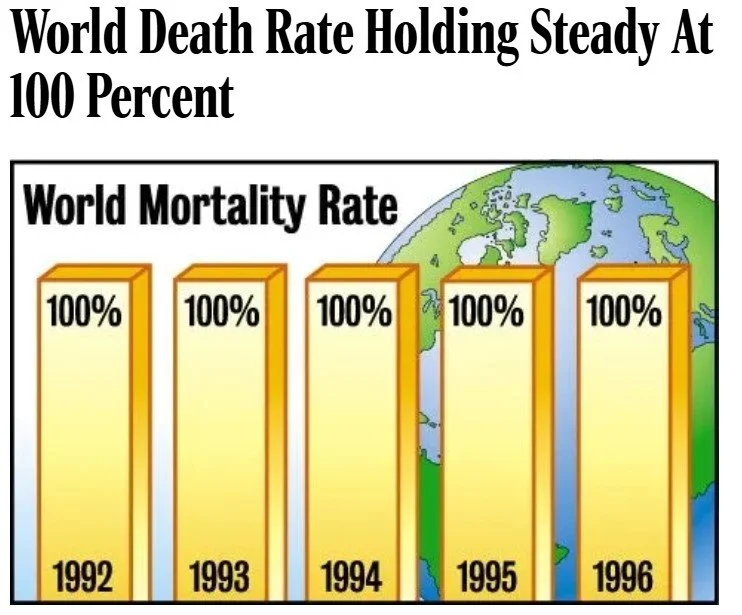
A headline from the satirical paper The Onion that never gets old.
Popcorn Time
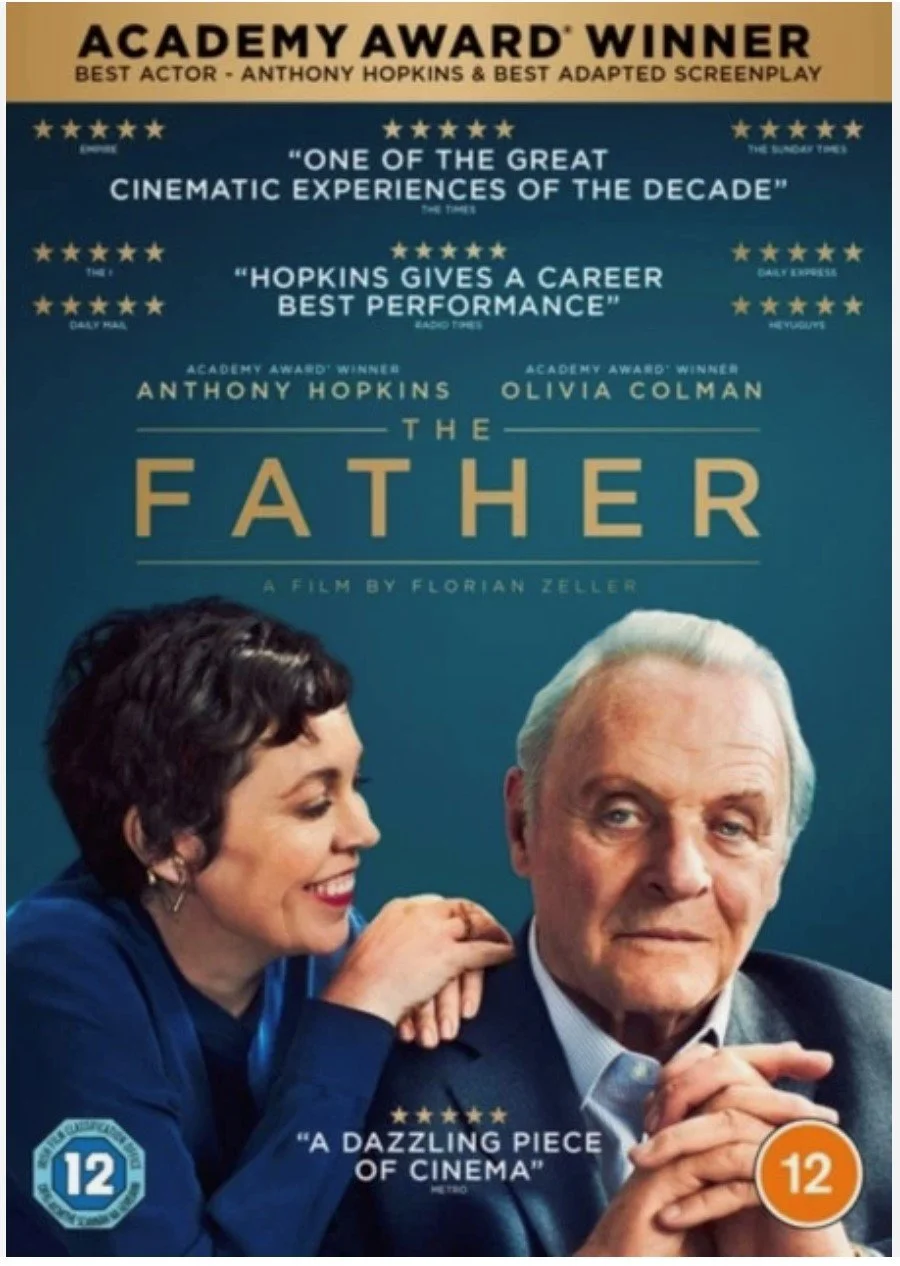
REVIEW:
"The Father"
by Florian Zeller
Reviewed by: David Coetzee
Rating: ★★★★½
The Father is a movie that you experience rather than watch. Anthony, 80, is a retired engineer and somewhat cantankerous widower. He appears listening to opera contently in an expensive flat in London where he lives on his own. When Anne his daughter arrives on her regular daily visit, he seems to be forgetting things. He complains to her that he has lost his watch and that it was probably stolen by his ex-carer. Anne tells him that she is moving to Paris with her new partner, but Anthony, to her surprise, says he is unable to recall that she has a new partner, since her divorce from her husband James some years ago. Anne tells him that if he continues to refuse to have a carer he will have to go to a nursing home.
In the following scene Anthony comes into his living room and finds an unknown man reading the newspaper. The man says that he is Paul, Anne's husband and that Anthony is in fact living in their flat. Anne arrives through the door of their flat as a different person.
The storyline does not feel cohesive as nothing makes sense nor is it chronological, but this is intentional, to get you into Anthony's mindset. In the beginning you are led to believe Anthony's experience is fairly rational and coherent but then in the next scene you are put into his shoes and perceive things the way he sees them. You realise that he has lost his memory and bearing and that the narrative is from his mind's perspective.
Later you are with him doubting his own understanding, when he is surprised the layout of the furniture and colours of the walls in the flat have changed, further manifesting his confusion, and again when different persons in his life switch roles with others in different scenes.
Anthony is aware of previous occurrences in his life but they come back into his mind with distorted reality, and sometimes recur. There are episodes of stark bewilderment, grief, charm, anger, fear and utter hopelessness as he is not able to work out what is going on and understand what is happening to him, and he falls apart emotionally. One truly sees dementia through his eyes.
You also begin to understand what it means to grieve for someone who is still alive. Anne becomes the parent of her father and continues to try to do everything she possibly can for him. Although she loves him dearly, it is not enough to help her understand and she struggles. Anne's husband Paul reacts unsympathetically and with aggression. Anthony is suffering in one way, and those around suffer in another.
Anthony Hopkins is amazing as Anthony and won the Oscar for best leading actor. The supporting performances are also excellent. Olivia Colman plays Anne, with empathy and vulnerability.
Florian Zeller directed and co-wrote the adapted screenplay with Christopher Hampton for which they also won an Oscar. Zeller directs admirably and the clever way in which he visually takes you into the mind of Anthony is superb. He handles the issue of dementia with honesty and respect.
This movie helped me understand and empathise with older people in our lives who have dementia, and those around them.
To watch DignitySA's recent webinar on the topic of Dementia & Caregiving, please visit https://www.youtube.com/@DignitySouthAfrica.
Good Reads
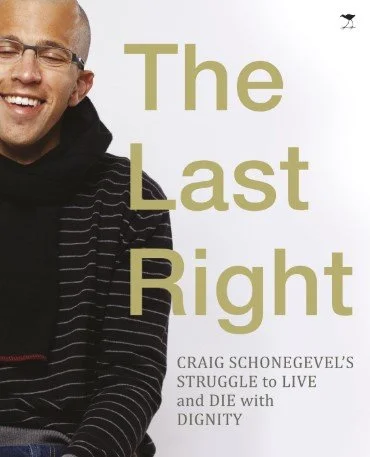
REVIEW:
"The Last Right"
by Marianne Thamm
Reviewed by: Patsy Schonegevel
Rating: ★★★★
Throughout his 28 years, our son Craig battled an aggressive variant of Neurofibromatosis Type 1 (NF1), a genetic disorder that causes tumors to grow on nerve tissue throughout the body. He was fiercely determined that his suffering would not be in vain. During the gruelling final months of his life, as his condition worsened and his application to Dignitas in Switzerland faced agonising delays, Craig began meticulously documenting everything.
To write The Last Right: Craig Schonegevel's Struggle to Live and Die with Dignity, Marianne Thamm spent six months immersed in Craig's world. She read through his private diaries, letters, and emails, and interviewed the people who supported him during his final days. Especially as they never met in person, his father, Neville, and I believe Marianne did an extraordinary job of portraying his story, his pain, his immense courage. Her book conveys why Craig's life and his death matter beyond the circle of those who loved him dearly.
Craig wanted his story to be told for many reasons. He wanted to contribute to the push for legislative change by exposing the harsh, inhumane reality of the current common-law prohibition on Medical Assistance in Dying (MAiD). He wanted to challenge the medical establishment, and he hoped our family's personal tragedy could be transformed into a powerful tool of advocacy for human rights and compassion.
For all of these reasons, it was incredibly moving for Neville and I to attend and speak at DignitySA's media event last month when they launched their historic constitutional challenge for MAiD to be made legal in SA. Marianne was there too, and we embraced and sat together. It has been almost 17 years since we lost Craig, and 13 years since his book was released, yet his story is more relevant today than ever. I encourage you to read it and join us in our shared quest to honour Craig's final wish.
South African Update
In the past two months, there has been extensive coverage about MAiD and our court application. Here is a sample:
Netwerk24: Net 1 Staan Aansoek oor Bystanddood Teen by Jana Breytenbach, 27 May 2026 (Afrikaans, paywall applies).
Cape Town Press Club: Prof Willem Landman Makes the Case for Medical Assistance in Dying (MAiD), 28 April 2026. To listen to the recording click here and enter the password dignity.
Business Day Editorial: Assisted Dying: Let the Courts, Not the Moralists, Decide, 15 April 2026 (paywall applies).
PowerFM: Understanding the Case by DignitySA on Assisted Dying, 12 April 2026.
Daily Maverick: The 'Last Right': DignitySA Approaches Court Over Medical Assistance for the Terminally Ill by Marianne Thamm, 10 April 2026.
News24: Landmark Case Demands Parliament Legalise Assisted Dying Within 24 Months by Marvin Charles, 10 April 2026.
The Citizen: Some People Die a Gentle and Easy Death, 9 April 2026.
SABC News: Calls to Legalise Assisted Dying Intensify, 9 April 2026.
Global News Round-Up
Global developments are showing us that while the public's demand for the legalisation of medical assistance in dying is at an all-time high, the institutional mechanics of finalising and preserving these laws face a great deal of resistance. Here is what has been happening around the world in the past two months.
United States: In Illinois, where an assisted dying law passed in late 2025 is slated to take effect this September, conservative lawmakers introduced a repeal bill in April to attempt to block its launch. Meanwhile, in Missouri, active bipartisan Death with Dignity bills faced hard stops as their legislative sessions wrapped up in mid-May without crossing the finish line.
France: Following the Senate's rejection of the Assistance in Dying Bill this month, President Macron's government is sending the bill back to the National Assembly. Backed by a clearer pro-reform majority, the government is aiming to override the Senate and secure final adoption before the summer recess in July.
United Kingdom: Following the fall of the Terminally Ill Adults (End of Life) Bill in May due to opposition within the House of Lords, campaign groups are laying the groundwork to reintroduce an identical bill. They are explicitly preparing to invoke the Parliament Act 1911 in the upcoming session when parliament re-opens. This Act is a rare constitutional mechanism that would allow the House of Commons to bypass the House of Lords' obstruction entirely and force the bill through to Royal Assent.
Jersey: Following the landslide 32 to 16 victory in late February that made Jersey the first jurisdiction in the British Isles to pass such a law, the legislation was formally transmitted to the UK Privy Council to await Royal Assent and hopes are high. With a timeline fixed on late 2027 for operational rollout, advocates are watching closely to ensure bureaucratic procedures in Westminster do not stall the democratic mandate of the island.
Australia: With Voluntary Assisted Dying available in all six states now, a recent major national report released by advocacy group Go Gentle Australia revealed that two-thirds of residential aged care providers offer no public information about VAD, and nearly 75% actively restrict or hide access within their facilities (a trend heavily driven by faith-based providers). This has sparked a fierce May debate over patient rights versus institutional conscience clauses.
Canada: With Medical Assistance in Dying well established federally, public pressure is mounting to allow competent adults to document a legally binding request for MAiD if they are later incapacitated by dementia, a framework that is currently only legal in Quebec.
More Articles From Our Website

Join Us
Our petition to decriminalise medical assistance in dying (MAiD) has garnered over 2,600 signatures and continues to grow: https://awethu.amandla.mobi/petitions/urgently-decriminalise-medical-assistance-in-dying.
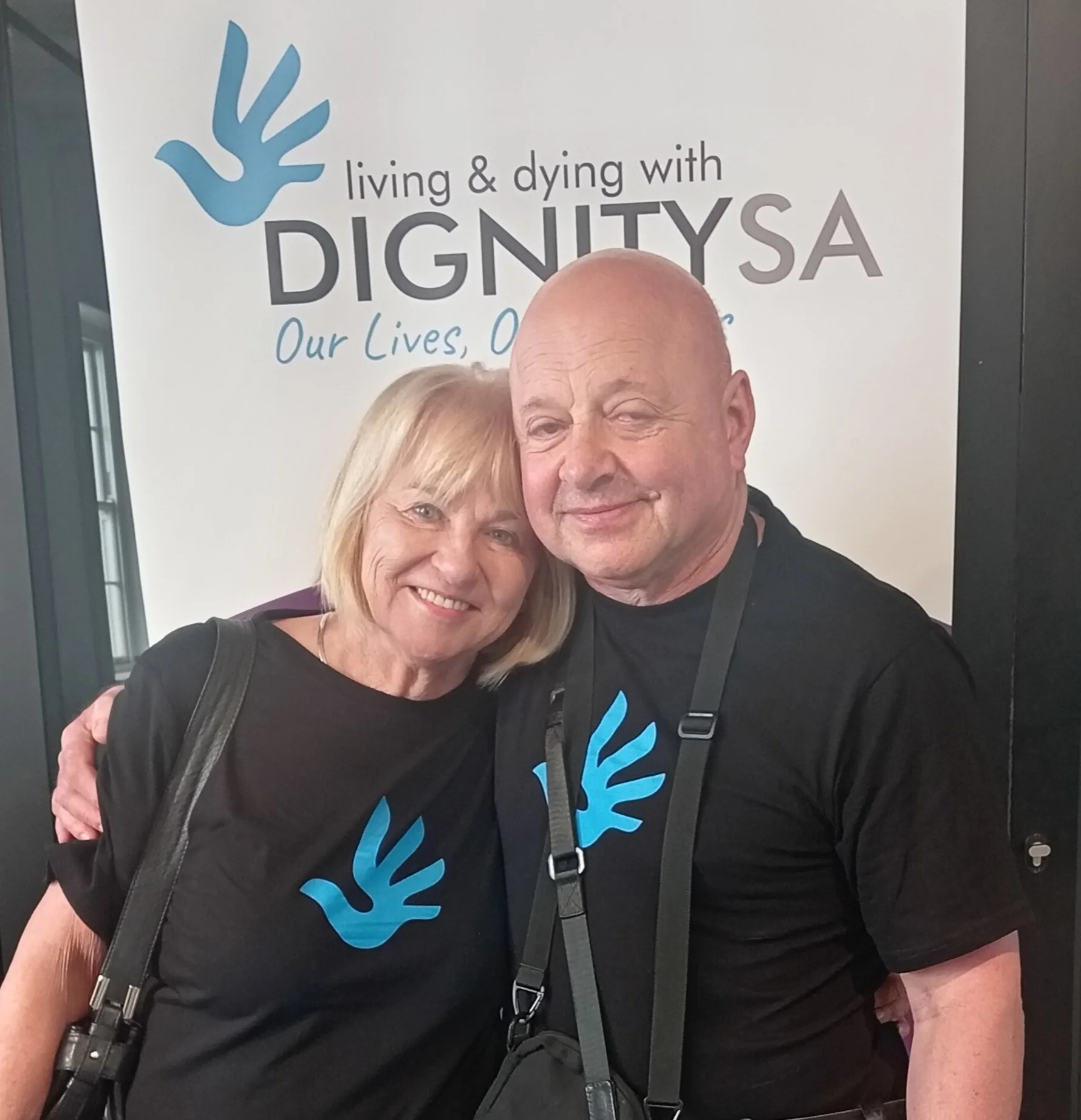
To join ambassadors like Patsy and Neville Schonegevel (pictured) please make a donation towards our legal costs and we will send you a DignitySA t-shirt of your own. Visit https://www.dignitysouthafrica.org/support#donate.
Poetry Apothecary

Meditations Before Kaddish
from the Mishkan T'filah
When I die give what's left of me away to children and old men that wait to die.
And if you need to cry, cry for your brother walking the street beside you. And when you need me, put your arms around anyone and give them what you need to give me.
I want to leave you something, something better than words or sounds. Look for me in the people I've known or loved, and if you cannot give me away, at least let me live in your eyes and not your mind.
You can love me best by letting hands touch hands, and by letting go of children that need to be free. Love doesn't die, people do. So, when all that's left of me is love, give me away.
