Dignity Matters
Our bi-monthly newsletter with interviews, expert input, entertainment, local and global news for the DignitySA community.

Guest Editorial

On the 9th of April we launched our constitutional challenge in the High Court in Pretoria, asking that the blanket prohibition on medical assistance in dying (MAiD) be declared unconstitutional for competent adults with a terminal or irremediable condition whose suffering cannot be relieved. As you will read in this issue's South African Update, the case is now moving. The Minister of Justice has indicated that she will abide by the court's decision, and we now await the answering affidavit of the Minister of Health. After more than four years of preparation, the argument we have built is finally being heard.
When I am asked to speak in the media there are a few topics that I am particularly passionate about. The first is that our call for MAiD is not a rejection of palliative care, in fact it is quite the opposite. At DignitySA we believe that good palliative care should be available to every South African from the moment of diagnosis, and far too few of us can access it. But, as our Advisory Trustee Rev. Mogomotsi Diutlwileng reflects so movingly in the Expert Input section of this newsletter (which was featured as an opinion piece in the Daily Maverick on the 26th of July), even excellent care cannot relieve all suffering in every case. To insist otherwise is to look away from how some people actually die.
The second is that MAiD is not a "slippery slope." I understand why people fear this, and the fear deserves to be taken seriously. But in jurisdictions that have carefully regulated assisted dying, with rigorous safeguards, independent assessment and protection against coercion, the catastrophes so often predicted have simply not materialised. We have meticulously gathered this evidence, from experts around the world, and placed it before the court.
When the legal and clinical arguments are set aside, what remains is something simpler and more human. We are convinced that a competent adult, of sound mind and facing an inevitable death, should not be forced to endure suffering they have clearly and repeatedly said they do not want. The real question is who gets to decide.
This issue of Dignity Matters holds that human thread throughout. You will find it in Herman Lategan's characteristically frank and funny Exit Interview, in my colleague Willem Landman's review of the tender movie The Sea Inside, in Linda Ravenhill's introduction to the helpful book With the End in Mind, and in the echoing wisdom of Maya Angelou's poem When Great Trees Fall. I hope you will read it in that spirit.
A court case of this kind is long, and it is costly, and I have personally put my own money towards it. If you believe, as I do, that it is a fight worth seeing through, there are three things you can do today. Please sign and share our petition, which we are aiming to grow to 5,000 signatures by the end of September. Please donate to DignitySA. And please consider joining us as a volunteer ambassador. You'll find details throughout this issue.
Thank you for standing with us.
Joseph Raimondo
Executive Director
Associate Professor Joseph Raimondo is Head of the Division of Cell Biology at the University of Cape Town. He holds a medical degree from UCT and a DPhil in Neuroscience from the University of Oxford, which he completed as a Rhodes Scholar, and brings the perspective of a medically trained neuroscientist to DignitySA's work. You can read his full bio here.
The Exit Interview
Dignity Matters poses some questions to:
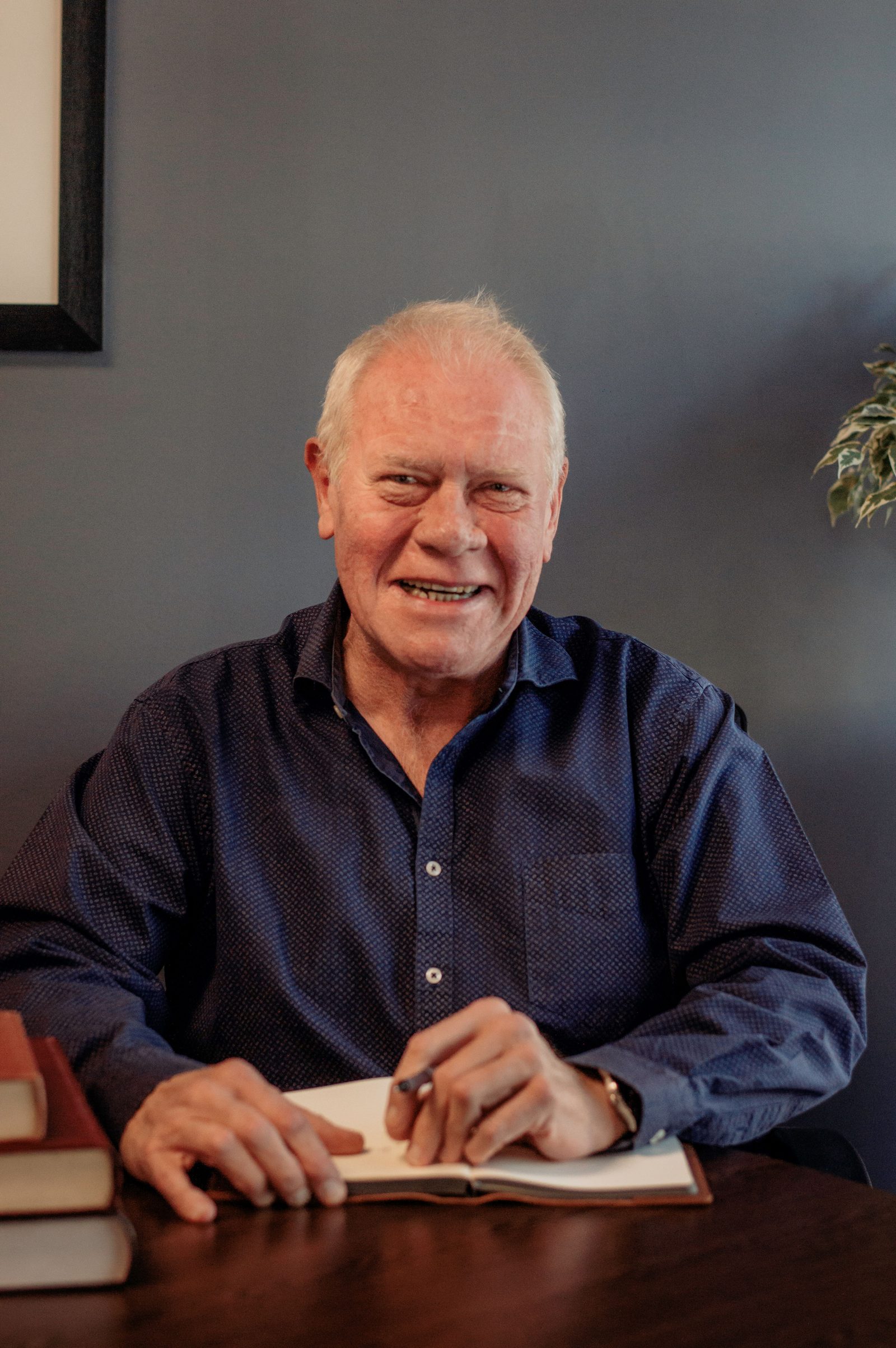
Herman Lategan is a creative nonfiction journalist who has been published locally and internationally. He has worked in radio and TV and is the author of four books. As the obituarist for the Daily Maverick, one of his many favourite forms of writing is the obituary. It is a difficult art form.
If calories and indigestion were no object, what culinary indulgence would be your last?
It would be a humble dinner prepared by my partner, Graham, consisting of his signature spaghetti bolognaise, with a side salad served with good old kômmin Knorr French Vinaigrette Salad Dressing. We would share a bottle of Bellpost Chardonnay and listen to Miriam Makeba, Ella Fitzgerald, Etta James and Billie Holiday.
Ideally, how would you like to go?
Quickly. The long goodbye scenario fills me with dread. I've witnessed too many of the latter.
In what publication would your obituary appear, and what would its glorious and slightly exaggerated but still truthful headline be?
I don't know if I'm important enough for an obituary, but our local knock-and-drop in Green Point is called the Atlantic Sun. Headline: Kind, friendly, arrogant and rude. Loved and hated by many.
Imagine your memorial service. What music would be playing? What band or artist would be grateful for the opportunity to perform?
I love the local, now defunct, band Bright Blue, they could sing Weeping. Jennifer Ferguson's Suburban Hum, and Etta James must sing (on CD) I'd Rather Go Blind. I love Brenda Fassie's Weekend Special, Amanda Strydom's Ek Sal Staan, and Anton Goosen's Boy van die Suburbs. Oh, and Pretty Yende, who can sing Il dolce suono (the "Mad Scene" from Donizetti's Lucia di Lammermoor), a highly demanding, virtuosic sequence that cemented her global operatic fame. It must be held at the Vasco da Gama Taverna in Green Point, also known as the Portuguese Embassy.
Burial or cremation? If transport, permissions and expense were no problem, where would you like to be buried, or have your ashes scattered?
I have donated my body to UCT's Division of Clinical Anatomy and Biological Anthropology. After a year, they cremate you. My ashes must be scattered at Three Anchor Bay, where I have some of my best memories as a little boy playing in the sand and catching sand sharks. I always threw them back into the water. I must return to them.
If you could choose one object to be buried or cremated with, what would it be and why?
I came into this world with nothing. I shall leave it with nothing. But if I should, it would be a poetry collection by Sheila Cussons, a poet who was like a mother to me in my stormy teens. It should be her first volume of poems Plektrum, published in 1970.
If you were to haunt someone after your demise, where would it be and why?
I wouldn't want to haunt someone once I'm gone. I have haunted enough people while alive. Bigots, editors, people who have deceived me, poseurs, materialistic grandees. They can rest easy now, I'm done with them. But if I'm allowed one exception, it would be Graham, just to sit quietly in the room while he makes his spaghetti bolognaise, the way I always did.
Who is in your will? And is there anything that you are leaving that may cause a fight?
Ha, I'm a journalist and writer, I hardly have money. But anything I might have left goes to my life partner of forty years, Graham Sonnenberg. If by chance there is enough, I'd also donate to DignitySA and the Durbanville Children's Home, where I spent a year of my childhood.
What do you still need to do before you kick the bucket?
I would like to visit South America. I have been to all continents of the world, including Antarctica, just not South America. Buenos Aires, mostly, for the melancholy of it, the tango bars, the faded duende. The latter is the presence of death, raw emotion, and dark vitality that makes art, places feel truly alive. Lorca distinguished it from the angel (grace) and the muse (inspiration): duende wounds, and that wound is its gift. It would also be great to visit Palestine when it emerges from this genocide, to walk through Gaza and see people rebuilding, living, laughing again.
Finally, is there anything you've secretly wondered about death, but been too polite to ask?
I often wonder about death. I have seen many people die in my life, and I have written hundreds of obituaries. I suspect it's lights out. It's the big secret, isn't it. Made to keep us humble, as humankind can fly people into space, transplant hearts, and be full of hubris, yet that one question remains unanswered for evermore. Only once you shut your eyes would you know. And that is part of the universe's plan to keep us humble and inquisitive.
Expert Input

Why I Have Chosen to Stand with Dignity SA
Reverend Mogomotsi Diutlwileng is an ordained Minister of the Methodist Church of Southern Africa. In this pastoral and theological reflection, he shares why he has chosen to join DignitySA as an Advisory Trustee. This opinion piece appeared in The Daily Maverick on 26 July 2026.
Every human being is created in the image of God and therefore possesses inherent worth, dignity, and sacred value. This conviction has shaped my ministry for more than two decades. It is also the reason I have chosen to publicly align myself with Dignity SA and its advocacy for Medical Assistance in Dying (MAiD).
Dignity SA is committed to advancing human dignity, compassionate end-of-life care, informed personal choice, and the development of an ethical and carefully regulated legal framework for MAiD in South Africa. At its heart, the organisation seeks neither to diminish the value of life nor to hasten death indiscriminately. Rather, it seeks to affirm that every person deserves to live and to die with dignity, compassion, autonomy, and respect.
My support for this cause is not merely theoretical. It is deeply personal.
My wife, Baagi, and I had the profound privilege and heartbreak of caring for both our mothers during the final stages of their lives. My mother lived with dementia until her passing. My mother-in-law endured relentless pain as multiple organs gradually failed before she eventually died.
Those experiences changed me forever.
We watched two remarkable women, once the strong matriarchs of our families, women of courage, discipline, wisdom, hard work, and independence, gradually lose the ability to care for themselves. The women who had once cared for everyone else eventually required assistance with every basic task of daily living.
The emotional and psychological burden of witnessing this slow decline is difficult to describe. Perhaps even more painful were the conversations with doctors who gently told us that medicine had reached its limits, that nothing more could be done except manage the inevitable journey toward death. The most telling thing of the entire experience was to see how my mother was taken to the hospital in an ambulance. After a month she was brought back in an ambulance, then feeding through a tube or G-tube.
As family members, we felt helpless. As a minister, I prayed. As a son, I grieved long before death finally arrived.
Those moments forced me to wrestle deeply with questions that every pastor eventually faces: What does it mean to preserve human dignity? What is the purpose of suffering? And what does genuine compassion require of us?
The Christian faith teaches that life is a precious gift from God. I hold that conviction wholeheartedly. Yet I also believe that human dignity involves more than merely biological existence. It encompasses our capacity to relate, to love, to contribute, to make choices, and to exercise responsible stewardship over our lives.
When terminal illness irreversibly strips away these capacities and leaves a person enduring unbearable suffering with no hope of recovery, we must have the courage to ask difficult ethical questions.
Throughout Scripture, suffering is never romanticised.
Job cried out in anguish. Jeremiah lamented his very birth. David poured out his pain in the Psalms. Even our Lord Jesus Christ prayed in Gethsemane that the cup of suffering might pass from Him before crying from the cross, "My God, my God, why have you forsaken me?"
These faithful witnesses did not celebrate suffering as a virtue in itself. Rather, they brought their suffering honestly before God.
Certainly, suffering can deepen faith, strengthen character, and cultivate compassion. Many believers, myself included, have discovered profound spiritual growth through seasons of hardship. Yet I struggle to see what divine purpose is served when a person who is irreversibly dying endures prolonged, excruciating suffering that medicine can neither cure nor meaningfully relieve.
Does God require such suffering?
I do not believe so.
Instead, I believe God calls us to embody mercy, compassion, and love. These are not abstract theological ideals but practical expressions of our discipleship.
For this reason, I believe society should seriously consider a carefully regulated framework for Medical Assistance in Dying.
Such a framework is not about abandoning vulnerable people. Quite the opposite. It should include rigorous legal safeguards, comprehensive medical evaluation, psychological assessment to ensure that the individual has full decision-making capacity, thorough counselling, informed consent, and independent professional oversight. Most importantly, any request for MAiD must originate solely from the patient, free from coercion or external pressure.
This is not a licence for abuse; it is a commitment to protecting both human dignity and human life while respecting informed personal choice in exceptional circumstances.
My support for Dignity SA therefore rests on several deeply held convictions.
First, I have personally witnessed the profound suffering of terminal illness and the heartbreaking loss of dignity experienced by those we love.
Second, I do not believe that unavoidable suffering at the end of life is inherently virtuous or that it somehow glorifies God simply because it is endured.
Third, I believe that personal moral agency—the God-given capacity to make thoughtful, responsible choices—is itself part of the dignity bestowed upon every human being.
Fourth, I believe that allowing a mentally competent adult, acting freely and with full medical understanding, to decide how they wish to face an inevitable death is ultimately a profound question of human dignity.
Finally, death is the one certainty we all share. Every one of us will eventually stand at that threshold. If, at that moment, a person of sound mind, guided by faith, supported by family, counselled by medical professionals, and protected by robust legal safeguards prayerfully concludes that they wish to receive medical assistance in dying, I believe their carefully considered decision deserves thoughtful respect.
As a minister of the Methodist Church, I recognise that faithful Christians will disagree on this issue. I respect those differences. Yet I also believe the Church has a sacred responsibility to accompany people compassionately through life's most difficult ethical questions rather than avoid them.
For me, supporting Dignity SA is ultimately about affirming the sacred worth of every person until their final breath. It is about compassion over judgement, dignity over despair, thoughtful discernment over fear, and love that honours both life and the freedom with which God has entrusted us.
That is why I have chosen to stand with Dignity SA.
On the Lighter Side
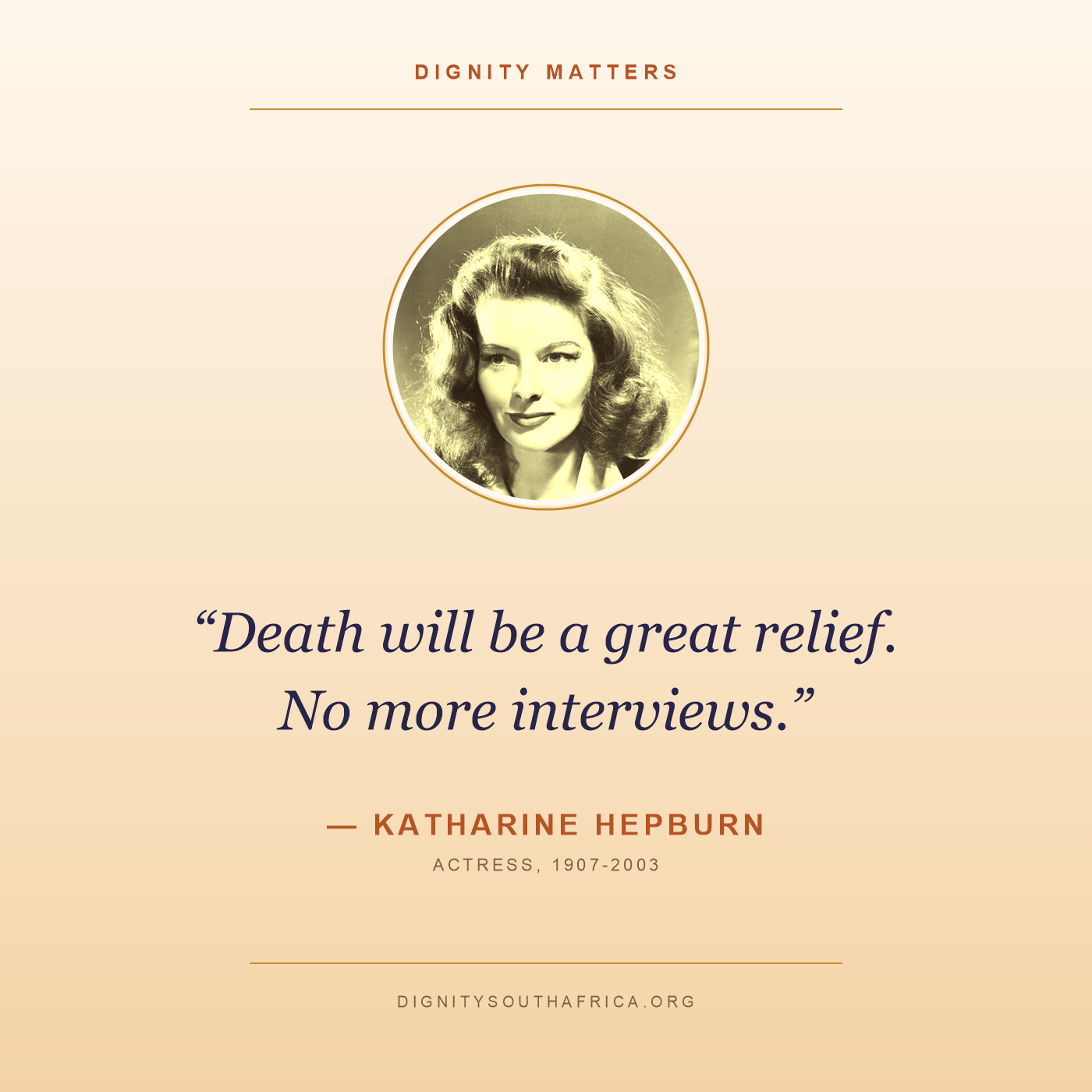
Publicity photograph of Katharine Hepburn, MGM, 1941 (public domain).
Popcorn Time

REVIEW:
"The Sea Inside" (2004)
by Alejandro Amenábar
Reviewed by: Prof Willem Landman
Rating: ★★★★★
It is 23 August 1968. Ramón Sampedro is a 25-year-old seaman, born 5 January 1943 in Porto do Son, a fishing village on the Atlantic Ocean in the northwestern corner of Spain's Galicia region, north of Portugal.
He goes for a swim at the nearby As Furnas. He jumps into the sea from rocks, misjudges the water's depth and strikes his head on the bottom.
Ramón is paralysed from head to toe.
Fast forward to 12 January 1998. The 55-year-old Ramón is found dead in an apartment in Boiro, also in Galicia, 30 km from the family farm in Porto do Son. His friends took him there two months earlier. One of them informed the police. The autopsy reveals traces of potassium cyanide in his blood and stomach.
His family did not want anyone prosecuted. Charges against his close friend, Ramona Maneiro, were dropped due to lack of evidence. No further charges were ever filed, in part because Ramón had assigned small tasks to each friend so that no individual could be convicted of assisting with his self-administered death.
From the time of the accident until his death, Ramón's family cared for him, lovingly doing all that accompanies total immobility. For more than 28 years. Every day.
Ramón read Swift, Wilde and Flaubert. He loved conversation and wrote an autobiography shortly before his death.
He could no longer bear the life of a tuned mind in an insensate body, completely dependent on his carers for all his needs. So, he opted for death. It was a choice he made for himself. He fully accepted that others similarly afflicted might lead fulfilled lives and choose differently. But he rejected the claims of church and state that he has an obligation to live and could not choose to die.
For five years, with the help of his lawyer, Julia, and others, Ramón sought legal permission for his sympathetic local doctor, Carlon Peon Fernandez, to help him. Ramón approached Spain's lower and higher courts, and even the European Commission on Human Rights in Strasbourg. He faced a legal vacuum. He considered going to the Netherlands.
He refused to fast to death because he knew the trauma it would mean for his religious, pro-life family. So, it was with his family in mind that his friends took Ramón away.
The film is about Ramón's "30-year campaign to win the right to end his life with dignity. The story also explores Ramón's relationships with two women and his ability to inspire them through his gift of love. A truly joyous experience. [It] celebrates the nature of freedom and love, and the mystery and beauty of life" (DVD cover).
The Sea Inside is a moving portrayal of Ramón Sampedro's life and death. It seamlessly takes the viewer from the life and relationships of an individual to profound questions of ethics and public policy.
Ramón justifies his choice to die on several grounds:
Lack of dignity and feeling degraded by his condition;
Lack of freedom to control his body, to experience intimacy and to choose whether he should live or die;
Lack of respect for his wishes;
The right to life does not entail an obligation to live;
The right not to be tortured (a right in Spanish law); and
Psychological pain.
Javier Bardem gives a highly credible and persuasive portrayal of Ramón's inner turmoil, his loves and friendships, and his justifications and resoluteness in his choice for death. Ramón's relationships – what is and what could have been – with Rosa, a visitor who becomes a friend, and Julia are portrayed with sensitivity and pathos.
The metaphor of the sea, with its visible tides and concealed currents, is instructive. Whereas the sea "outside", the Atlantic, is where Ramón becomes a paraplegic, the sea "inside" is the theatre where his inner mental life is lived, its outward expression constrained by his severely limited physical life.
Ramón is confined to a body that does not work. In a telling moment in the film, his hand rests on his bed, centimetres from that of Julia, but his inability to reach out for a simple touch of hands illustrates the chasm he cannot bridge.
As Ramón's legal battle becomes public knowledge via television, he generates attention and receives visitors, like Padre Francisco, a quadriplegic Catholic priest, who seeks to convince him that he should continue to live. Ramón takes strong exception and his sister-in-law, Manuela, asks Francisco to leave.
Family members are divided. Ramón's elder brother, José, does not believe he should have the right to die and is angry about others' sympathy for Ramón's choice to die. But both Manuela and her son, Javier, support him.
And so do his friends, who, in a daring and moving show of solidarity, liberate him, not only from the bedroom in which he was cloistered, but from the life he felt was no longer worth living.
Ramón was not terminally ill, but his suffering was real, protracted, and increasingly unbearable. Padre Francisco, who tries to persuade Ramón to want to live, in effect seeks to hold him hostage to the consequences of ethical and religious beliefs he does not share.
The Sea Inside raises the question whether non-terminally ill quadriplegic or paraplegic individuals would be vulnerable should medical assistance in dying (MAiD) be legalised. Would they feel that their lives are not worth living? Would they experience pressure to opt for death? Or would their decision to opt for death be uncoerced, unencumbered and free?
In the film, there is a hint of this when Ramón's brother, José, angrily tells Ramón that they are all his prisoners because they had to look after him, but also because he disregards their feelings when he chooses death.
This is a real concern that must be addressed by a responsible, legal practice of MAiD. Appropriate safeguards must be put in place and administered. But there is no evidence of abuse of quadriplegic or paraplegic individuals in jurisdictions where MAiD is legal. That said, some uninformed individuals may still feel threatened or insecure.
On 18 March 2021, Spain's parliament legalised medical assistance in dying (both self-administered and physician-administered) for individuals with serious, incurable illnesses or chronic, debilitating conditions causing intolerable suffering. Although Ramón was not terminally ill, the legal aid he sought thus eventually became a lawful option on 25 June 2021.
The Sea Inside won 67 awards worldwide, including the Academy Award for the Best Foreign Language Film, the Golden Globe Award for the Best Foreign Language Film and the Best Actor in a Motion Picture Drama. It features Javier Bardem in the lead role as Ramón Sampedro and Belén Rueda as Julia.
This review was provided by Prof Willem Landman. Willem is DignitySA's Chair and Co-founder, and holds degrees in philosophy, political philosophy, theology and law from the Universities of Stellenbosch, Oxford (as a Rhodes Scholar) and Unisa. He has chaired philosophy departments in South Africa and held a chair in Medical Humanities in the United States. He is the founding CEO of the Ethics Institute of South Africa and a co-founder of the international journal Developing World Bioethics.
Good Reads
REVIEW:
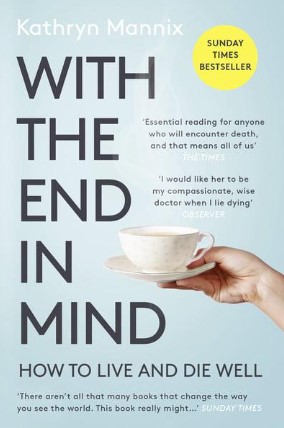
"With the End in Mind"
by Dr Kathryn Mannix
Reviewed by: Linda Ravenhill
Rating: ★★★★
"The death rate remains 100 percent, and the pattern of final days and the way we actually die are unchanged. What is different is that we have lost the familiarity we once had with that process, and we have lost the vocabulary and etiquette that served us so well in past times, when death was acknowledged to be inevitable."
These words, from the introduction to Kathryn Mannix's eloquent and profound book With the End in Mind, reflect something that lies at the heart of so much of our pain and unnecessary suffering around our end of life: that as a society, we have forgotten how to talk about, and how to experience death as a natural part of life.
Mannix is not someone who writes about death from a distance. Having worked as a doctor in cancer care, and then as a pioneer of the palliative care movement, for more than thirty years she has sat with death, again and again, bringing everything she knows about the human mind and human heart to those moments.
With the End in Mind is the book in which she offers readers "…my eyes and ears, my seat at the bedside, my place in the conversations, and my perspective on events."
Structured around the stories of her patients, it is, at its heart, a collection of the most intimate moments of the human experience: Patricia, a matriarch dying of heart failure; Eric, navigating life with Motor Neuron Disease; Holly, a young mother with two small girls, trying to hold on to everything she loves.
Each story is told with such care and attentiveness that you feel the weight of the moment, the tenderness of the relationships within it, and the profound humanity of the people at its centre. And in reading each story, you come away changed in ways that stay with you long after you finish the final chapter.
Mannix's argument is both simple and quietly radical: that dying, in the vast majority of cases, follows a recognisable, gentle pattern; one that we have forgotten how to witness, and in forgetting, have made far more frightening than it needs to be.
She is not asking to romanticise death. She is asking us to stop pretending that death is something we can avoid, and instead to embrace the conversations that are an essential part of facing it. Because, as she shows again and again, it is not death itself that causes so much suffering, but our reluctance to acknowledge it and prepare for it.
Despite being a book about death and dying, With the End in Mind is not a sombre book. Instead, its pages are filled with moments of quiet humour, humanity, and unexpected moments of connection.
Mannix writes with a lightness of touch that never diminishes the gravity of what she is describing. She is funny, candid, and, above all, deeply compassionate. The same can be said of the people whose stories she shares. Together, they reflect the full spectrum of human experience: ordinary and extraordinary, heartbreaking and hopeful, but ultimately courageous and wise.
These are stories that linger with you, not because they dwell on death, but because they illuminate life. And in doing so, they offer something many of us don't realise we need: comfort.
But perhaps most importantly, With the End in Mind is as much a book about how to live as it is about how to die.
For at the end of our days, most of us want the same things: a life well lived, and a death met with dignity and love. Kathryn Mannix makes a quietly powerful case that both are more possible than we may have dared to believe.
This review was provided by Linda Ravenhill. Linda is Editor and Programme Director at The Medical Education Network, with a background in the medical sciences and a Master's degree in Journalism from the University of the Witwatersrand. Her work sits at the intersection of medicine, ethics, and storytelling. Her research has explored death and dying, with a particular interest in how medicine, culture, and communication shape the way we experience the end of life.
 South African Update
All four of the respondents in our constitutional challenge have engaged in the past two months now. Significantly, the 'justice cluster' (the Minister of Justice and Constitutional Development and the National Director of Public Prosecutions) have indicated that they will not oppose and rather abide by the decision of the court. The Minister of Health has undertaken to provide their answering affidavit by Friday the 31st of July and the Health Professions Council of South Africa (HPCSA) have not provided a date.
Our case has been lodged with the motion court and will be heard on the documentation (rather than having witnesses appear in court) and on legal argument by the opposing parties in court. As this is a public interest case, DignitySA will be approaching the Deputy Judge President of the North Gauteng High Court to ask for a case management directive that provides timelines for parties to file their papers.
It is clear that our court case will be protracted and it is critical that our organisation is sustainable and in a position to see the case through to conclusion. To this end we recently launched a crowdfunding campaign to raise $200,000 from supporters locally and abroad. The campaign can be found at https://www.globalgiving.org/projects/give-south-africans-the-final-freedom/.
Our petition to Decriminalise Medical Assistance in Dying is now housed on our own website and we are aiming to reach 5,000 signatures by the end of September. Please help us by encouraging your networks to show their support at https://www.dignitysouthafrica.org/petition.
 Global News Round-Up
From legislative battles in Paris and Westminster to institutional pushback in Australian care homes, June and July demonstrated that securing and preserving the right to die requires constant vigilance. Every procedural victory brings us closer to a world where personal autonomy at the end of life is universally respected.
France: President Macron's government was able to secure adoption of the Assistance in Dying bill before their summer recess. On the 15th of July the French National Assembly delivered a monumental victory, voting 291 to 241 to pass the bill on its final reading. This significant victory now faces one last procedural hurdle. Prime Minister Lecornu has referred the text to France's Constitutional Council to evaluate key elements (including the mandatory two-day reflection period and conscientious objection provisions) before the law can be formally promulgated.
Jersey: On the 9th of July 2026, Jersey achieved a milestone when the Assisted Dying (Jersey) Law 2026 officially received Royal Assent from the UK Privy Council. Jersey is now officially the first jurisdiction in the British Isles to enact assisted dying legislation. The island has now entered an 18-month implementation phase and recruitment for key administrative and clinical roles is already underway to prepare for a late 2027 rollout.
United States: Opposition attempts introduced in April to repeal Illinois's landmark End-of-Life Options for Terminally Ill Patients Act failed to gain legislative momentum through June and July. The law remains firmly on track to take effect this September, making Illinois the first state in the American Midwest to offer medical aid in dying. Meanwhile, state legislatures in Missouri and other conservative states officially wrapped up their legislative sessions without passing active Death with Dignity bills, underscoring the political divide surrounding end-of-life autonomy.
United Kingdom: Following the collapse of the Terminally Ill Adults (End of Life) Bill in the House of Lords in May, the bill was formally reintroduced to the House of Commons in June by MP Lauren Edwards. Campaign groups spent July coordinating with pro-reform lawmakers to lay the groundwork for invoking a rare constitutional mechanism (the Parliament Act 1911) that will allow the democratically elected House of Commons to bypass the House of Lords entirely and push the bill through to Royal Assent.
Australia: Following the publication in May of a damning report by Go Gentle Australia, which revealed that nearly 75% of residential aged care providers restrict or hide Voluntary Assisted Dying (VAD) access, June and July saw fierce public backlash against faith-based facilities. State oversight bodies and advocacy organisations are actively lobbying state governments to amend institutional "conscience clauses." The goal is to prevent faith-based residential facilities from blocking VAD assessors or denying residents access to vital end-of-life information.
More Articles From Our Website

Join Us
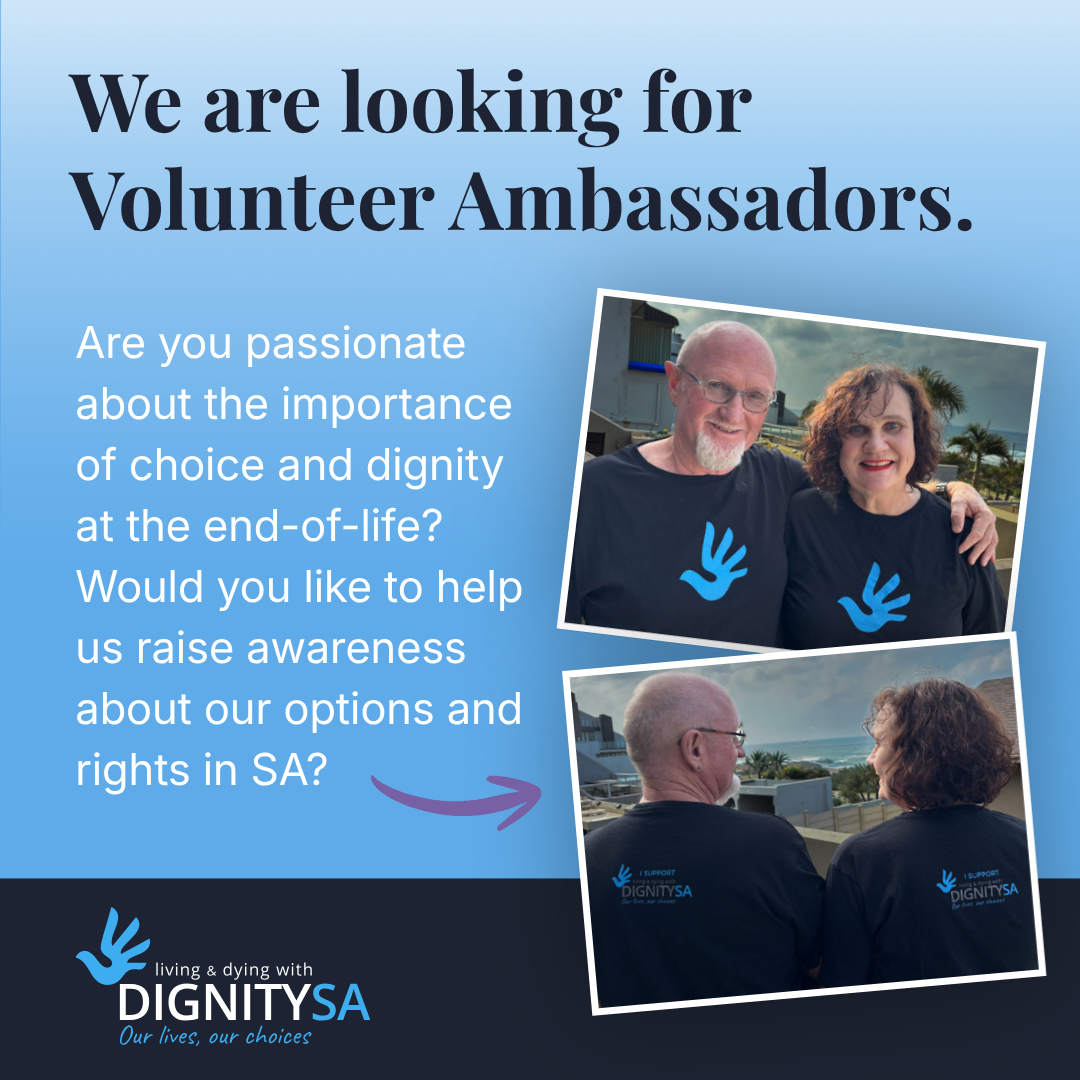
We will be hosting our first online Meet & Greet with prospective volunteers at 4pm on Wednesday the 29th of July. DignitySA Ambassadors assist us with:
giving talks and presentations on our four focus areas: palliative care, refusing or withdrawing treatment, advance directives, and law reform on medical assistance in dying (MAiD);
helping people understand and complete advance directives and end-of-life planning documents; and
representing DignitySA at community events and answering general questions about our work.
Please register to attend by clicking here and then a Zoom link will be sent to you. If you are unable to join us for this session, please write to [email protected] to join our next one.
Poetry Apothecary
When Great Trees Fall
by Maya Angelou
They existed. They existed.
We can be. Be and be
better. For they existed.
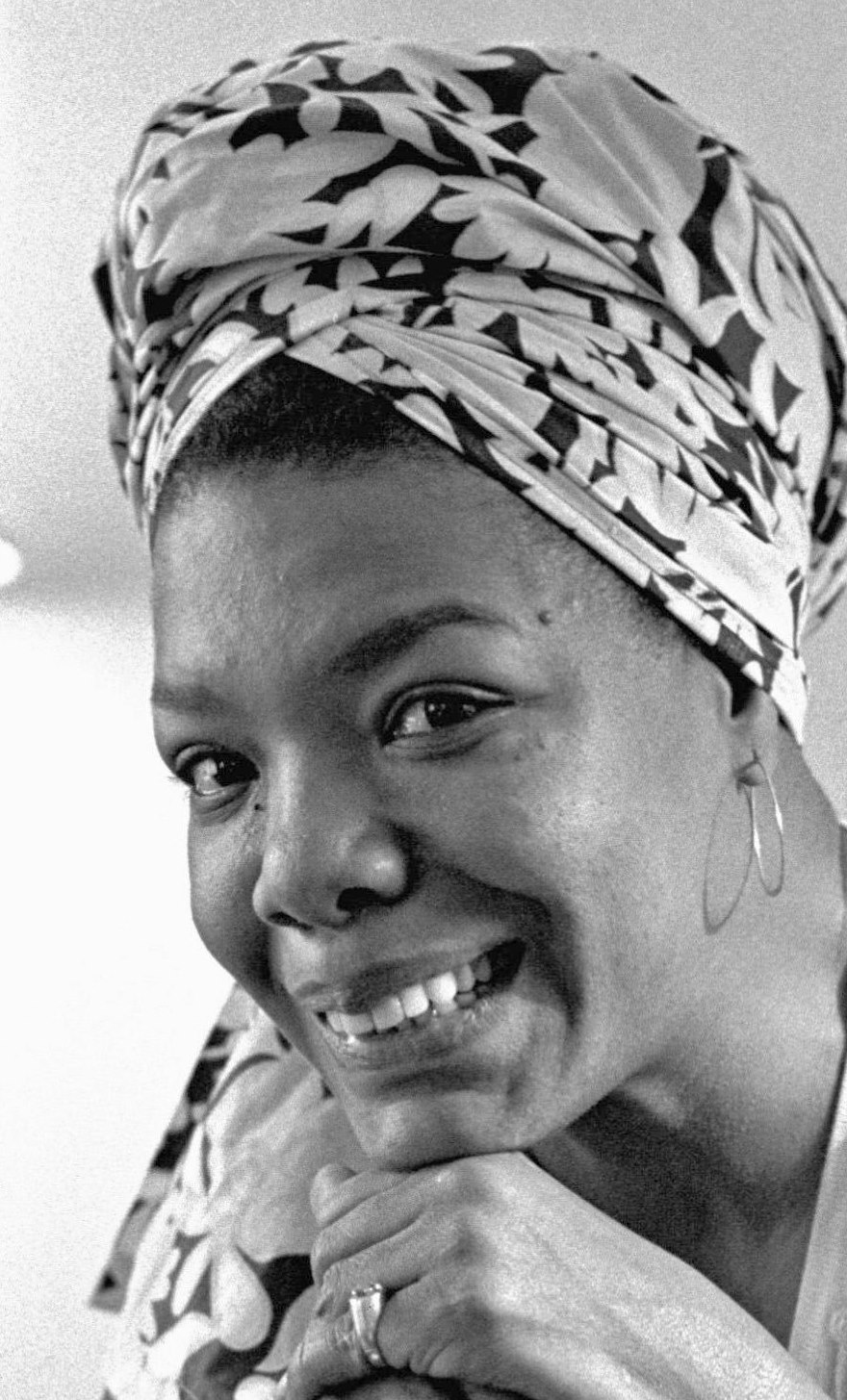
Closing lines from Maya Angelou's poem "When Great Trees Fall". You can read the full poem here. Photograph of Maya Angelou, 1971 (public domain).
